
United Methodists Ratify Plan to Restructure Denomination
New plan decentralizes the role of the United States

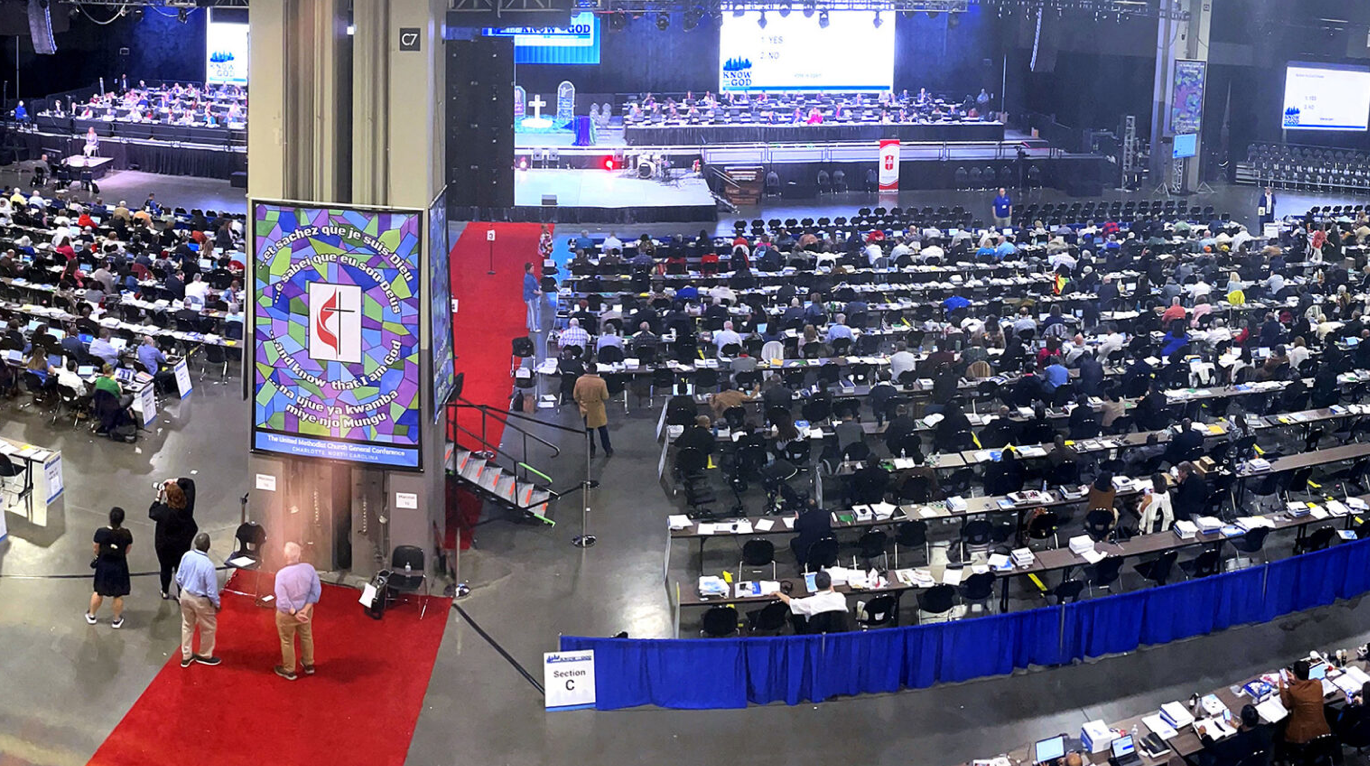
(RNS) — After years of controversy over LGBTQ issues that split their denomination, United Methodists have ratified a plan to restructure the 57-year-old church to give regions around the world equal standing and greater freedom to tailor church life to local customs and traditions.

FILE: United Methodist General Conference in Charlotte, N.C., in May 2024. (Photo by Larry McCormack, UM News)
The so-called “regionalization plan” received overwhelming support, with 91.6% of United Methodists voting in favor of constitutional amendments to change the church’s structure, according to a church statement. The tally was 34,148 to 3,124, with both clergy and lay people voting in each conference, or regional body.
The plan decentralizes the role of the U.S., which gave birth to churches in Europe, the Philippines and Africa. Each of its nine regions across four continents will now have the ability to set its own qualifications for ordaining clergy and lay leaders, write original hymnals and rituals, compose their own rites for marriage and establish judicial courts.
Among the things that cannot be amended from one region to another are the church’s constitution, its doctrinal standards or its positions on social issues such as human rights, economic justice or care for creation.
The vote completes the process that began in April 2024, when the regionalization plan passed the General Conference, the denomination’s top legislative body. Since then, the denomination’s 120 annual conferences have been learning about the four constitutional amendments and then voting on them. The denomination had tried and failed to restructure before in an attempt to avoid schism over global differences on controversial issues, especially on whether to allow United Methodist ministers to perform same-sex ceremonies or ordain church leaders who identify as LGBTQ.
Access to MinistryWatch content is free. However, we hope you will support our work with your prayers and financial gifts. To make a donation, click here.
The inability to come to consensus resulted in the departure of more than 7,600 United Methodist churches in the U.S. — 25% of all U.S. congregations — in recent years. Even with those churches gone, differences remain: Last year, the church in the United States fully affirmed LGBTQ identities and lifestyles, a step churches in the Philippines and in Africa have not made.
But with greater unity among the congregations that remained in the United Methodist Church, it was able to move ahead with restructuring after the 120 annual conferences voted with overwhelming approval.
In a statement, Council of Bishops President Tracy S. Malone called the vote “a defining moment in the continuing renewal and unity of The United Methodist Church.”
But her push for greater equality among the denomination’s regions was also framed as an effort to decolonize the church. Born of an 18th-century movement begun by John and Charles Wesley, the Methodist movement through its various schisms and realignments has for centuries been centered in the United States.
“There was a very strong feeling that the U.S. needed to not be the center of the church,” said Judi Kenaston, chief connectional ministries officer for the Connectional Table, a sort of denomination-wide church council that played a critical role in developing the plan. “We can’t make rules for everybody.”
While church regions in Africa, the Philippines and Europe have already had some leeway in customizing church life, the United States has not.
A committee will now be established to organize the United States into its own regional conference. Each region will also be able to revise some sections of its Book of Discipline, or rulebook, to fit with local custom and tradition.
MAIN PHOTO: TO OUR READERS: The mission of MinistryWatch is to help Christian donors become more faithful stewards of the resources God has entrusted to them. Do you know of a story that will help us fulfill our mission, or do you want to give us feedback about this or any other story? If so, please email us at [email protected].
Related posts:
![Christian Reformed Church Codifies Homosexual Sex as Sin in its Declaration of Faith]()
Christian Reformed Church Codifies Homosexual Sex as Sin in its Declaration of Faith
![Sewanee Students Call for University to Revoke Honorary Degree Given to Eric Metaxas]()
Sewanee Students Call for University to Revoke Honorary Degree Given to Eric Metaxas
![LGBTQ Advocacy Group Closes Due to ‘Serious Internal Issue’]()
LGBTQ Advocacy Group Closes Due to ‘Serious Internal Issue’
![Australian Anglicans Split over Same-Sex Marriage]()
Australian Anglicans Split over Same-Sex Marriage
![Scottish Venue That Canceled 2020 Franklin Graham Event to Pay Over $100K for Violating UK Equality Act]()
Scottish Venue That Canceled 2020 Franklin Graham Event to Pay Over $100K for Violating UK Equality Act