
The Strange Fruit of the Second Great Awakening
Commemoration of the August 1801 Cane Ridge Revival is a moment for reflection

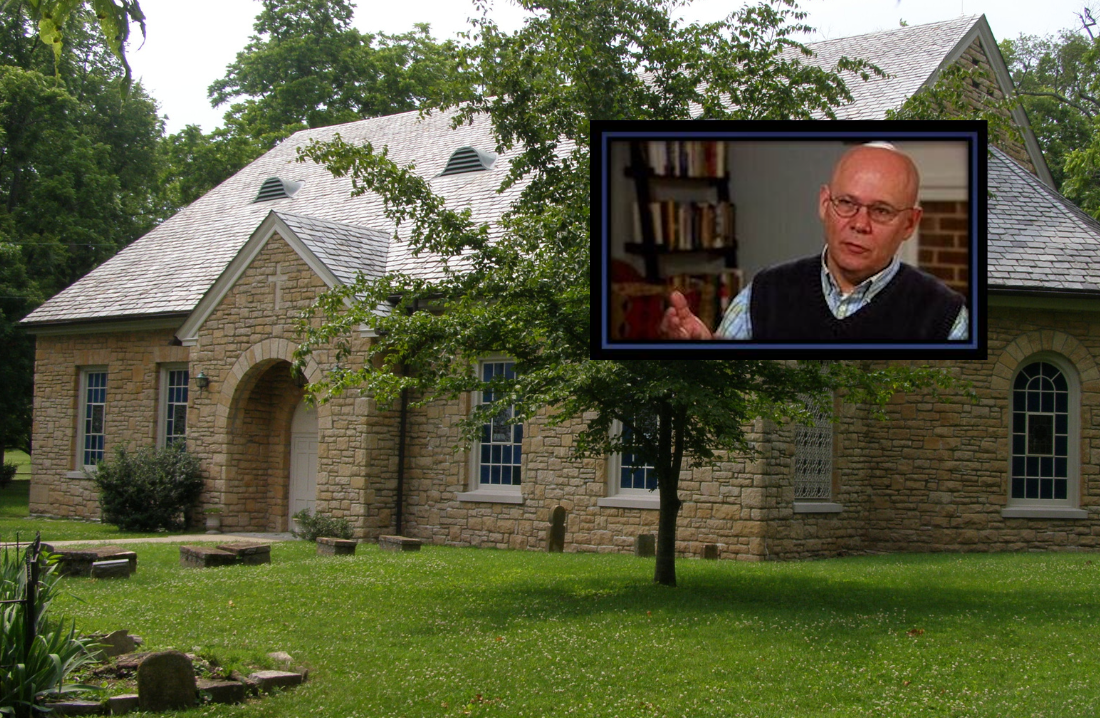
In August of 1801 — 225 years ago this month — a great religious movement swept the country brought with it the phenomenon of the camp meeting. The famous Cane Ridge, Kentucky, meetings of that summer attracted as many as 10,000 people — at a time when Lexington, Kentucky’s largest city, had less than 2,000 people.
Photo by Chris Light / Wikimedia Commons
To celebrate the anniversary earlier this month, a group of about 200 people gathered at the meeting house where the revival began. Bobby Ross, a journalist who was there, wrote this:
Two hundred filled the Cane Ridge Meeting House, where the Stone Memorial Building now encases the restored one-room log church originally built in 1791. Attendees parked in the grass alongside State Highway 537, surrounded by tobacco, soybean, and corn fields.
The gathering this past Saturday drew members of a cappella Churches of Christ, independent Christian Churches and the Christian Church (Disciples of Christ). All three groups trace their modern-day roots to the Restoration Movement, also known as the Stone-Campbell Movement.
It is understandable that many celebrate the Cane Ridge Revival, but the true story is more nuanced.
Unlike the First Great Awakening, led by such figures as Jonathan Edwards and George Whitfield, the Second Great Awakening that the Cane Ridge Revival began was more raucous and freewheeling. Some admirers of that quality call it a sign of the Holy Spirit. Others attribute it to a triumph of entrepreneurism and technique. Cane Ridge provided an operations manual, and those who attended Cane Ridge attempted to duplicate it in format if not in result.
Charles Finney, one of the architects of the Second Great Awakening, later wrote, “A revival of religion is not a miracle, nor dependent on a miracle in any sense. It is a purely philosophical result of the right use of the constituted means — as much so as any other effect produced by the application of means.”
Camp meetings therefore took on a predictable format, which included preaching and prayer, but also meals and socializing. Annual camp meetings sprang up. Families would build cabins where the meetings happen annually. Some of these cabins became substantial, and still exist in places like Ocean Grove, N.J., and Shiloh Methodist Campground in Mississippi. The annual revival meetings became cultural events as much as religious events.
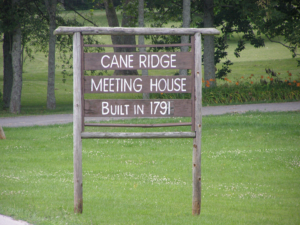
Photo by Chris Light / Wikimedia Commons
These camp meetings resulted in large crowds and claims of many conversions to Christianity, but the lack of doctrinal depth of both the preachers and the converts caused many to turn away from faith and many more to go astray.
The Second Great Awakening produced the Restoration Movement, as Bobby Ross noted. It also gave birth to the Cumberland Presbyterians, which grew throughout the 19th century, but which has less than 30,000 active members today and is one of the most progressive Protestant denominations. The Second Great Awakening also produced cults such as the Jehovah’s Witnesses (1870s), Mormons (1830s), Christian Science (1870s), Spiritualism (1840s), Christadelphians (1850s), and Unity (1889).
Utopian social experiments, such as the Oneida community, sprang out of the Second Great Awakening. An apocalyptic sect called the Millerites taught that the Second Coming would take place in 1844. When that did not happen, many of Miller’s followers joined Seventh-Day Adventist churches, and the impact of his thinking is still alive in that denomination.
The Second Great Awakening also saw the rise of premillennial dispensationalism. There is no “one size fits all” description of premillennialism. But, in general, premillennial dispensationalism holds that there will be a rapture of the church. This rapture is followed by a tribulation in which great hardship will occur for those left behind. During this time of tribulation many will come to faith, in part because the sudden and unexpected disappearance of hundreds of millions or even billions of Christians will convince many of a coming judgment. This remnant will stand against the Antichrist, who will emerge in this chaotic time. Jesus will return to lead this remnant in a final battle, which he and his followers will win, and Jesus will begin a 1,000-year reign — the millennium — on earth.
If this brief description sounds familiar, that’s because it has been popularized by modern evangelicalism. An important reason for the adoption of this eschatological view came in 1970, when premillennialism got a huge boost from one of the nation’s largest evangelical publishers, Zondervan. It published a book by Dallas Theological Seminary graduate Hal Lindsey called “The Late Great Planet Earth.” The book has sold a reported 35 million copies, is still in print, and is one of the bestselling religious books of all time. Lindsey himself, despite having many of his predictions and prophecies fail to occur, remained a popular speaker in churches and on television into his early 90s.
Access to MinistryWatch content is free. However, we hope you will support our work with your prayers and financial gifts. To make a donation, click here.
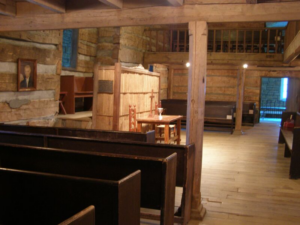
Photo by Chris Light / Wikimedia Commons
The “Left Behind” books of the 1990s also had a significant impact on evangelical thinking. The authors of this series — Tim LaHaye and Jerry Jenkins — had been well established in evangelical circles long before the first “Left Behind” book was published in 1995. The series remains a brisk seller even now, 30 years after the publication of the first book, having passed the 30 million mark. The books have also spawned movies and video games.
Is the Cane Ridge Revival the source of all these pathologies of the modern church? Of course not. But the recent spate of news coverage commemorating the event does give us an opportunity to reflect. To remember that ideas have consequences, and bad ideas have victims. And that sometimes when innovation occurs, we do not always know the true impact of that innovation until many years later.
TO OUR READERS: The mission of MinistryWatch is to help Christian donors become more faithful stewards of the resources God has entrusted to them. Do you know of a story that will help us fulfill our mission, or do you want to give us feedback about this or any other story? If so, please email us at [email protected].