
Former Christian Aid Ministries Worker Indicted for Child Sexual Abuse in Haiti
Jeriah Mast was formerly sentenced for child abuse in Ohio.

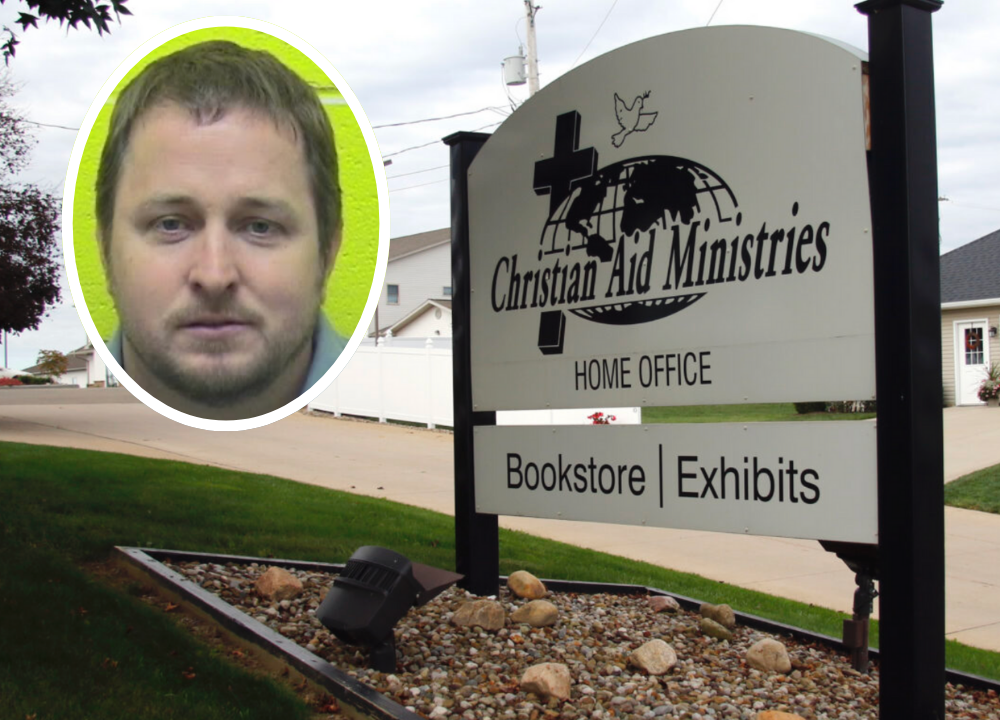
A former worker with Christian Aid Ministries was recently indicted by a federal grand jury for engaging in illicit sexual activity with minors while in Haiti.
Photo of Christian Aid Ministries sign by Tom E. Puskar (AP Photo via RNS) / Inset of Jeriah Mast
Christian Aid Ministries, closely aligned with conservative Anabaptist groups, is an international Christian relief and development organization that provides humanitarian aid in poverty-stricken nations around the world.
According to the U.S. Department of Justice, Jeriah Mast, 44, traveled to Haiti on multiple occasions from 2002 to 2019, including trips with Christian Aid Ministries, and during his visits he abused children in the country. The indictment includes four victims against whom Mast perpetrated his alleged crimes.
Acting Assistant Attorney General Matthew R. Galeotti described Mast’s actions as “heinous, unspeakable crimes against vulnerable children living in an impoverished nation.”
Galeotti assured the public that although Mast committed the alleged abuse in another country, the Department of Justice would continue to seek justice for the victims.
Mast was also indicted in 2019 in an Ohio county court with seven felony charges of gross sexual imposition and seven misdemeanor charges of sexual imposition, according to NBC News. Those crimes took place in Ohio between 1998 and 2008.
Mast eventually reached a plea agreement with prosecutors and had a nine-year sentence imposed. However, according to WKYC, Mast was granted early release in October 2025.
Access to MinistryWatch content is free. However, we hope you will support our work with your prayers and financial gifts. To make a donation, click here.
During a May 2019 interview with the Holmes County Sheriff’s Office in Ohio, Mast “admitted to law enforcement that he molested 30 or 31 boys in Haiti over a span of about 15 years.” The current federal indictment involves the abuse of those Haitian minors.
According to an affidavit filed by Jason Guyton, a federal Homeland Security Investigations (HSI) special agent, the agency received a tip in May 2019 that Mast had been engaging in sexual activities with minors in Haiti.
HSI learned of Mast’s admissions to Ohio law enforcement where he admitted to abusing Haitian children beginning in the early 2000s and continuing until as recently as eight weeks prior to the 2019 law enforcement interview.
Mast provided a list of the Haitian children he had abused, and Guyton began interviewing the victims in Haiti, who confirmed Mast’s abuse. Victim 1 was about 13 years old when the abuse began in 2004. Guyton’s affidavit contains graphic descriptions of the alleged abuse.
Christian Aid Ministries admitted in a letter in 2019 that two of its managers had knowledge of Mast’s sexual abuse of minors as early as 2013 after he admitted to sexual activity with boys under the age of 18. They were later placed on administrative leave pending an investigation.
The board of Christian Aid Ministries agreed to provide assistance for confirmed Haitian victims, including at least $420,000 in payments to victims for housing, business start-up funding, relocation costs, and vocational training.
In May 2020, Christian Aid Ministries announced it had reached a settlement agreement in a civil case brought by Haitian sexual abuse victims.
In order to prevent such cases in the future, the ministry said it was working to improve its hiring process and supervision of staff.
“Current efforts are focused on more robust background checks and screening. [Christian Aid Ministries] is also strengthening current whistleblower and accountability programs. To accomplish these goals, [Christian Aid Ministries] will provide updated training to employees on how to take more effective action should they become aware of inappropriate behavior or abuse,” the ministry said.
According to its website, Christian Aid Ministries is still working in Haiti, including assisting victims of Hurricane Melissa.
In the MinistryWatch database, Christian Aid Ministries has an A Transparency Grade, and financial efficiency rating of 5 Stars. It has a Donor Confidence Score of 96.
EDITOR’S NOTE: MinistryWatch exists to help donors become more effective stewards of the resources God has entrusted to them. So, why does MinistryWatch report on sex crimes? These stories are tough to read and sometimes even tougher to report, but we think they are vital to our mission to bring transparency, accountability, and credibility to the evangelical church. Donors who are supporting these ministries need to know this information. Ministry leaders and others can learn lessons from these stories. Victims feel supported. To read more about why and how we report these stories, read “Why MinistryWatch Reports On Sex Crimes.”
Another reason we report on sex crimes is to highlight for ministry and church leaders the importance of employing best practices for hiring and supervising employees in Christian environments.
Below is a list of best practices, curated from content on ministrywatch.com. These are adapted from discussions on Christian ministries, churches, and Christian educational institutions.
Clarifying Mission and Faith-Based Requirements
- Clearly define and document the organization’s religious mission to guide all hiring decisions, ensuring that faith alignment is central.
- Assess personnel needs based on what is required to fulfill the mission, recognizing that requirements may vary by role (e.g., teachers in a Christian school might need to model faith in curriculum delivery).
- Develop detailed job descriptions that explicitly link positions to the mission, including necessary faith commitments, conduct standards, and how they connect to the religious identity.
- Require candidates to affirm a statement of faith (e.g., a restatement of the Apostles’ Creed) to ensure they share the organization’s beliefs, as this is protected under federal laws like Title VII for religious nonprofits.
- Implement policies where employees assent to the mission, receive training on their role in it, are held accountable, and are treated consistently in evaluations or issues.
Avoiding Nepotism and Conflicts of Interest
- Create written anti-nepotism policies prohibiting direct reporting relationships between relatives (e.g., spouses or siblings) and limiting family members’ involvement in hiring, firing, or reviews.
- Establish boundaries to prevent conflicts, such as excluding relatives from decision-making roles in personnel matters.
- Promote transparency and open communication with staff and stakeholders about family hires to build trust and address potential issues.
- Adhere to any denominational guidelines, such as restrictions on family members serving on oversight boards or committees.
- Use resources like sample policies from the Evangelical Council for Financial Accountability (ECFA) and seek professional advice to tailor policies.
Thorough Vetting and Background Checks
- Conduct comprehensive investigations into candidates’ past, especially regarding allegations of misconduct like abuse, using independent firms if needed for objectivity.
- Create confidential channels for reporting concerns or additional information during the hiring process.
- Make relevant assessment findings public (while protecting sensitive details) to demonstrate integrity.
- Include spousal interviews or family vetting to assess overall fit with organizational values, though this should be handled carefully to avoid legal risks.
Legal Compliance and Conduct Expectations
- Hire based on shared faith and mission alignment, as federal law (e.g., Title VII) allows Christian organizations to prioritize believers without discrimination claims.
- Enforce a code of conduct aligned with “Judeo-Christian” values (e.g., prohibiting gossip or certain personal behaviors), but ensure it complies with anti-discrimination laws and does not overreach into protected areas like pregnancy or religion.
- Train new hires on core values, such as working “as unto the Lord,” to integrate them into the ministry culture.
- Be aware of limits: Secular aspects of the organization cannot mandate specific religious practices, and at-will employment allows flexibility but must avoid violations of federal protections.
These practices emphasize stewardship, accountability, and protection against legal challenges, such as those from employment laws or state requirements.
Related posts:
![Top 80 Largest Christian Ministries by Revenue: 2022 Rankings and Financial Insights]()
Top 80 Largest Christian Ministries by Revenue: 2022 Rankings and Financial Insights
![Christian Ministries Continue Work on Relief, Rebuilding after Earthquake in Haiti]()
Christian Ministries Continue Work on Relief, Rebuilding after Earthquake in Haiti
![Missions Groups Wary As Haiti Kidnappings Increase With Recent Abduction Of 17 People]()
Missions Groups Wary As Haiti Kidnappings Increase With Recent Abduction Of 17 People
![Ransom Freed Some Missionary Hostages in Haiti, Workers Say]()
Ransom Freed Some Missionary Hostages in Haiti, Workers Say
![50 Largest Relief and Development Organizations – 2024]()
50 Largest Relief and Development Organizations – 2024