What Would Billy Say?
Decision of Samaritan’s Purse and Billy Graham Evangelistic Association to leave ECFA is defining moment

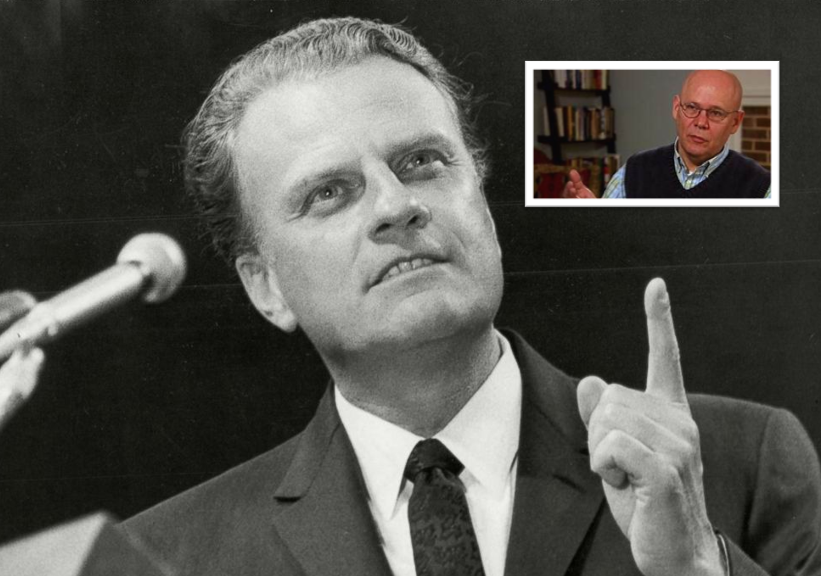
OPINION–In October of 1948, Billy Graham and his ministry team — Cliff Barrows, George Beverly Shea and Grady Wilson — held evangelistic meetings in Modesto, Calif. These men gathered in their spare time to write what Barrows came to call the “Modesto Manifesto.” That document outlined the standards they would follow regarding “financial integrity, sexual morality, publicity, and partnership with the local church.” 
It is therefore no surprise that the Billy Graham Evangelistic Association (BGEA) was one of the charter members of the Evangelical Council for Financial Accountability (ECFA) when that organization began in 1978. Three years later, Samaritan’s Purse (SP) joined the ECFA. Today both organizations are led by Billy Graham’s son, Franklin Graham.
In July, both organizations left the ECFA, citing objections to a new standard with which all ECFA members will have to comply. That standard, “Excellence in Leader Care,” says this:
Every organization’s board and senior leader shall work together to develop a care plan for the senior leader. The plan shall be approved annually by the board to demonstrate the organization’s commitment to caring proactively for the leader’s well-being and integrity.
As with all ECFA standards, this one included a bit of explanation. This commentary said that a “board (or a board-approved committee) and the senior leader (CEO, Lead Pastor, or equivalent) to partner together to create a plan that provides proactive care for the holistic well-being of the leader and supports his or her integrity.” The commentary also says the board (or committee) should document this annual discussion.
This standard is not onerous. Still, Franklin Graham objected. In a July 2, 2025, letter notifying the ECFA of the withdrawal of both SP and BGEA, he wrote that this standard “puts ECFA into the role of trying to be the moral police of the evangelical world.” He went on to say:
This Leader Care standard seems to be a knee-jerk reaction aimed at preventing the kind of high-profile moral failures the world has witnessed in recent years in our evangelical ranks. However, there is a common denominator in all these cases that the new Leader Care standard does not address and certainly cannot prevent – lying. Virtually every leader who has fallen morally (and particularly by sexual sin) had become good at lying – to a spouse, family members, staff, board members, accountability partners, pastors, and so on. If a leader is living in sin and lying to the spouse about it, lying to board members about the amount of time they are spending in the Word will be easy. This is ultimately a sin problem, with its root in the human heart, which only God can fix – not ECFA, even with a mountain of standards.
Franklin Graham makes some good points here, but he also propagates a few half-truths — and even the valid points are mostly irrelevant to this situation.
Access to MinistryWatch content is free. However, we hope you will support our work with your prayers and financial gifts. To make a donation, click here.
For example, Graham is right that a “mountain of standards” won’t fix a sin problem, but that is not what standards and rules and laws attempt to fix. Laws, standards, and rules don’t change hearts, but they can and do change behavior, and they provide consequences for bad behavior.
They also perform what some legal theorists call a “didactic” or “pedagogic” function. In other words, they set cultural norms and teach the members of a society, a culture, or a sub-culture (including corporations and organizations) what is acceptable and unacceptable behavior. Laws against murder and rape do not eliminate these crimes, but they do clearly identify them as crimes, with appropriate punishments. That process can indeed act as a deterrent. To argue that the ECFA’s new standard won’t solve man’s “sin problem” is both 100% accurate and 100% beside the point.
Graham is also right, or at least he is probably right, that the ECFA implemented this standard because of recent high-profile scandals in the church, scandals that have included Jerry Falwell Jr. and Liberty University, Mark Driscoll and Mars Hill Church, and Ravi Zacharias International Ministries. But in all three of these cases, the major failure was not (necessarily) that the leader was lying. The bigger problem was that their boards utterly failed to ask questions, either out of fear or a calcified board culture. In these three cases and many others we have covered at MinistryWatch, the board abdicated their responsibilities to hold the leaders accountable. This new standard will make plain what the board’s duties are.
However, and finally, Graham’s contention that the new standard would make ECFA the “moral police” is simply wrong. This new standard has no such language or aspiration. Rather, it attempts to codify a behavior that good boards already do and it provides guidance for all boards seeking best practices. It does nothing more than help boards fulfill their legal, fiduciary responsibility to hold accountable the leaders of the organizations they oversee.
The ECFA issued a statement today (Oct. 10), formally announcing its new standard. In that statement, ECFA President Michael Martin says,
Today, leader burnout, dropout, and tragic breaches in trust are among the greatest risks undermining confidence in the integrity of Christ-centered organizations. We’ve seen the cost – ruptured relationships, reduced morale, declines in giving, and a widespread weakening of our Gospel witness. The entire ministry community and the people we serve suffer when healthy leadership is compromised. But we are not powerless bystanders. The time is now for ECFA’s new standard of care.
Franklin Graham disagrees, and that is — of course — his prerogative. But it’s not hard to imagine the men who signed the Modesto Manifesto in 1948 reading Michael Martin’s statement and responding with a hearty “Amen.”