

Warren Smith’s Quarterly List of Books Worth Noting
Sometimes brutal tales disguise redemptive lessons.

Editor’s Note: Most weekends we feature this “Editor’s Notebook” column. MinistryWatch President Warren Smith will offer his opinion on stories in the week’s news or, sometimes, offer a behind-the-scenes look at how and why we do what we do. However, once a quarter (or so), we use the ‘Notebook” for Warren Smith’s list of books either released in the past quarter, or those he just got around to reading this quarter. To read last quarter’s list, click here. 
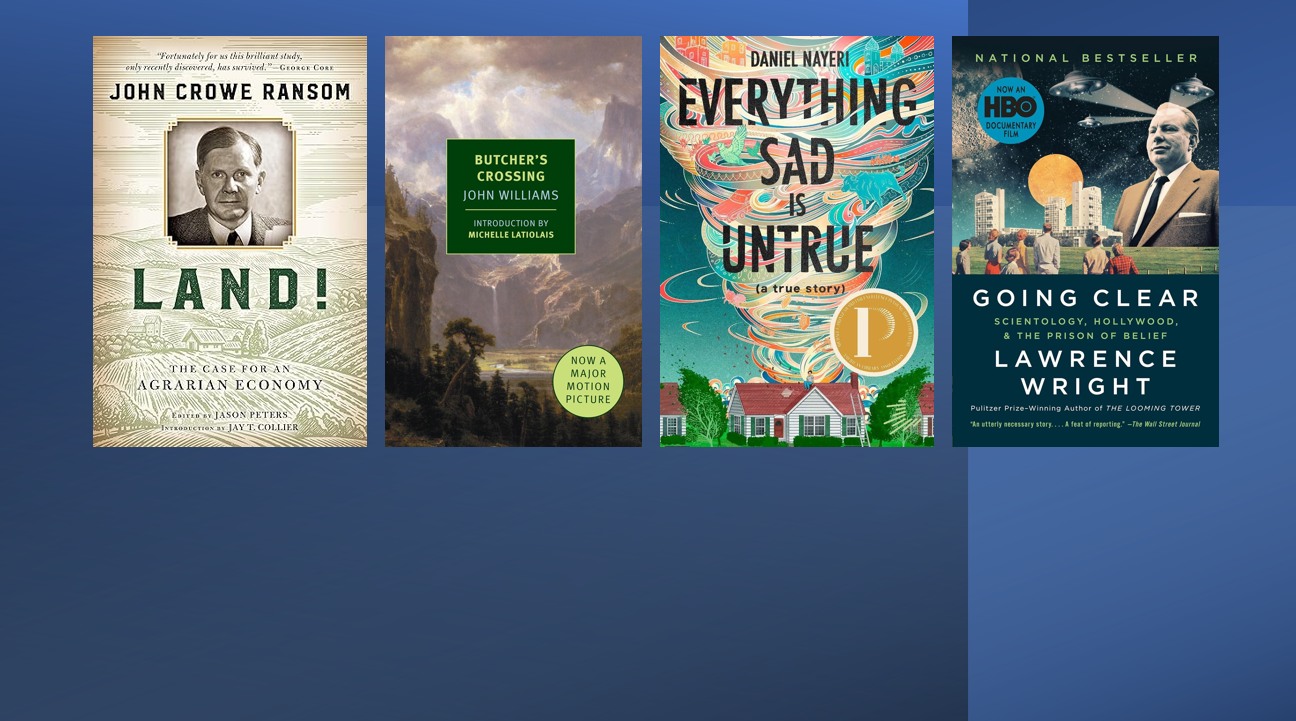
Everything Sad is Untrue by Daniel Nayeri. This moving autobiographical novel is about storytelling, suffering, faith, and identity. Written from the perspective of a middle-school boy named Khosrou—who later becomes Daniel—the book recounts his family’s escape from Iran after his mother converted from Islam to Christianity. Because conversion carried serious consequences in post-revolutionary Iran, the family fled as refugees, eventually arriving in the United States after years of uncertainty and hardship. The book offers a compelling picture of the cost of discipleship and the courage of believers who risk everything for faith in Christ. It also challenges readers to show compassion toward immigrants and outsiders. The book argues that suffering does not erase beauty or truth. Instead, redemption often emerges through brokenness, memory, and hope.
The Room Where It Happened: A White House Memoir by John Bolton. Bolton spent 17 months serving in the Trump White House as national security advisor, but he has been a major player in national security matters for decades. Bolton portrays the administration as deeply chaotic, driven more by political calculations and personal relationships than by coherent strategy or principle. The book details internal conflicts among advisors, diplomatic negotiations with world leaders, and Bolton’s growing frustration with what he viewed as inconsistent leadership and weak national security decision-making.
For Christian readers, the memoir raises important questions about character, truthfulness, power, and moral leadership in public life. While Bolton himself writes primarily as a policy hawk rather than from an explicitly religious perspective, the book invites reflection on the biblical importance of wisdom, integrity, humility, and accountability among leaders. Christians may also see in the memoir a cautionary reminder that political loyalty should never replace commitment to truth and ethical responsibility.
Going Clear: Scientology, Hollywood, and the Prison of Belief by Lawrence Wright. This book has been on my reading list for a while, but at more than 500 pages, it is a heavy lift, and I kept putting it off. That concern was misplaced. The book is gripping and the pages fly by. This book is what the sub-title teases: it is not just about Scientology, but also about the cult of celebrity and the way irrational belief can become a prison.
Evangelicalism is subject to some of these pathologies, and that is why this book is helpful for Christian readers. It is a cautionary tale that could apply to any religious movement that becomes focused on power, personality, secrecy, and institutional control rather than truth and spiritual health. Christians who read it carefully may recognize patterns that can emerge in any religious environment: celebrity leadership, fear-based loyalty, suppression of dissent, exaggerated spiritual claims, and the temptation to protect institutions at all costs.
Access to MinistryWatch content is free. However, we hope you will support our work with your prayers and financial gifts. To make a donation, click here.
Land: The Case For An Agrarian Economy by John Crowe Ransom. In 1930, poet John Crowe Ransom was the spiritual and literary father of a group of young men who wrote a collection of essays called “I’ll Take My Stand.” That book became the founding testament of the Agrarian movement, a movement that spawned many literary and philosophical children and grandchildren — including Richard Weaver, Wendell Berry, Marion Montgomery, Rod Dreher, and Allan Carlson. In indirect ways, even modern localism and new urbanist movements owe a debt to the Agrarians.
Ransom wrote a follow-up book that attempted to unpack some of the economic ideas of Agrarianism. Long thought lost, it was found and edited by Jason Peters and this book, published in 2017, makes a fine addition to Agrarian studies. Ransom argues that industrial modernity has weakened human community, spiritual depth, and respect for creation. Writing during the rise of mass industrialization in the early twentieth century, Ransom and the Southern Agrarians contended that economies rooted in agriculture, localism, family life, and stewardship produce healthier societies than systems driven solely by efficiency, consumption, and endless economic growth.
Not every argument in the book has aged well, and readers should approach it critically, especially regarding its romantic treatment of the Old South. Yet the book remains provocative because it asks questions modern Americans rarely consider: What kind of economy best forms virtuous people? What happens when work becomes detached from place, family, and creation? Can technological progress coexist with spiritual health?
Christians should read the book today because many of its concerns resonate with biblical themes of stewardship, Sabbath, neighborliness, and limits on material ambition. The authors challenge believers to think carefully about consumerism, environmental degradation, and the loss of local community. Even readers who reject the Agrarians’ conclusions may find the book a valuable corrective to assumptions that bigger, faster, and richer always mean better.
Butcher’s Crossing by John Williams. I am a fan of western novels. I even wrote one. I am one of those who believes, with literary critic Dr. Ben Vorpahl, that all American literature is Western literature — from the dark frontier land of Nathaniel Hawthorne’s “The Scarlet Letter” to Huck Finn’s impulse to “light out for the territory.” “Riders of the Purple Sage” by Zane Grey, “Lonesome Dove” by Larry McMurtry, even Nathaneal West’s “The Day of the Locust” and Jack Kerouac’s “On The Road” and Jon Krakauer’s “Into The Wild” are tales of Western adventure that attempt to shed light on the American experience.
Of course, there are a lot of pulp and dime-store westerns, too. But the best of the genre rises to the level of literature. “Butcher’s Crossing” is a worthy addition to the literary category. The book is set in the 1870s and follows Will Andrews, a young Harvard dropout who travels west to the rough Kansas town of Butcher’s Crossing seeking authenticity and adventure beyond the comforts of civilized life. He joins a buffalo hunting expedition led by the obsessive frontiersman Miller, who is determined to find a hidden valley filled with untouched buffalo herds.
As the expedition progresses, the hunt becomes increasingly brutal and spiritually empty. Miller’s relentless pursuit of success blinds him to danger, morality, and common sense. The men become trapped by winter in the mountains, surrounded by the carcasses of slaughtered buffalo whose hides cannot even be sold profitably. By the novel’s end, Andrews realizes that the frontier does not offer transcendence or freedom from human weakness; instead, it exposes pride, greed, and existential emptiness.
Christians should read the novel because it is a powerful meditation on idolatry, especially the temptation to seek salvation through conquest, experience, or self-discovery apart from God. The book also confronts readers with humanity’s capacity to exploit creation without stewardship or restraint. Its spare prose and moral seriousness encourage reflection on ambition, suffering, humility, and the illusion that fulfillment can be found solely through individual freedom or material achievement. (A tip of the Stetson to Nick Poe, who recommended this book to me.)