
St. Andrew’s Chapel Votes to Leave PCA
The church still claims authority over members under discipline.

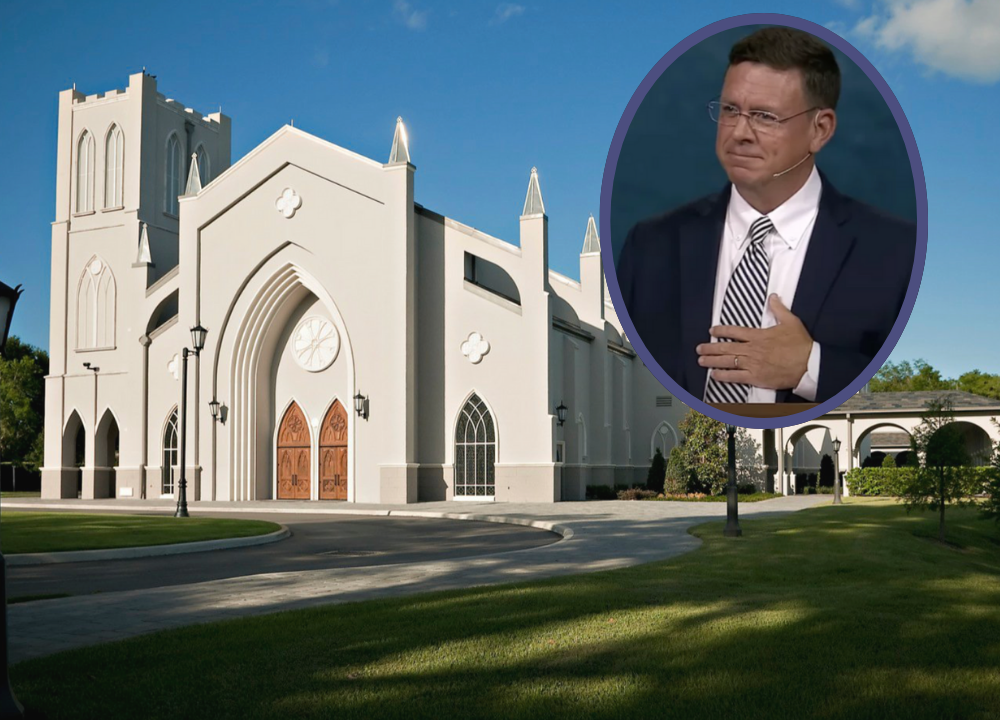
St. Andrew’s Chapel in Sanford, Florida, voted on Sunday (Dec. 14) to leave the Presbyterian Church in America (PCA) by a vote of 669 to 108.
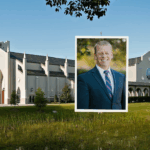
St. Andrew’s Chapel in Sanford, Florida / Insert of Burk Parsons
The church, originally led by Dr. R.C. Sproul, joined the PCA in 2023. It first considered a vote to leave this summer, but delayed the vote while referring the matter to the church’s board of elders, also known as its session, to study the situation and return with a recommendation.
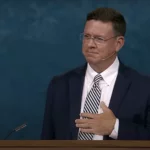
Its lead pastor, Burk Parsons, was suspended from his role as a teaching elder in the PCA in June after being found guilty by a church judicial commission of three charges related to, among other things, a “domineering” and “intimidating” leadership style, which included accusations of bullying and slander. He is currently appealing the decision to the denomination’s Standing Judicial Commission. Parsons is also the chief editorial officer for Ligonier Ministries.
A letter to the St. Andrew’s congregation dated December 5 said the elders originally planned to wait until Parsons’ appeal to the commission was resolved, but that “recent developments” prompted it to act sooner.
Those “recent developments” refer to actions by the Central Florida Presbytery, a regional body of elders that has authority over the churches in its area, who issued the guilty verdict against Burk Parsons.
In June, the presbytery instructed St. Andrew’s to share its financial information with members who request it. The church had refused to do so leading up to that point.
The presbytery wrote, “In Presbyterianism, transparency is central to its governance, which is built on a representative system of elders, called and elected by congregations…The PCA Book of Order mandates that church proceedings—such as session meetings or general assemblies—be conducted openly, with minutes recorded and accessible to members. Transparency reflects the Reformed theological belief that the church discerns God’s will collectively, requiring access to information for all involved.”
St. Andrew’s leadership complained that the Central Florida Presbytery acted in ways that were more “disciplinary” and not as “pastoral.” It also cited the release of a complaint to the media — MinistryWatch — that it says “inflicted pastoral and reputational injury on our church and leadership.”
The complaint in question that allegedly inflicted reputation injury was originally released at the August 19 Central Florida Presbytery meeting. The presbytery had passed a motion to release all documents pertaining to any cases coming before the presbytery so members could review them before the next meeting on October 14. The complaint was one of those documents released to over 200 elders.
MinistryWatch published the content of the report that it received from an anonymous source. The complaint, compiled by St. Andrew’s elder David Zima, included information about the reported compensation for the pastors at St. Andrew’s Chapel.
After the complaint was published more broadly through MinistryWatch’s reporting, a motion was made at the October presbytery meeting that whoever shared the “confidential report” with MinistryWatch should “repent” for violating the peace and purity of the church—but the motion failed. This outcome “deeply troubled” St. Andrew’s Chapel elders.
In its letter to the congregation, St. Andrew’s criticized Zima’s initial report and cast doubt on it by saying it was “withdrawn.” However, Zima told MinistryWatch that though the church said he withdrew his report, it did not tell the congregation that he resubmitted an updated and revised version days after.
Following its vote to leave the PCA, St. Andrew’s said it intends to “remain independent” for a season “while studying potential future fraternal relationships with other churches for mutual accountability and encouragement, rooted in the Westminster Standards and open to cooperation with other confessional Reformed bodies.”
John Maynard, the moderator of the Central Florida Presbytery, told MinistryWatch that the presbytery played no role in the congregation’s vote and that it immediately removed the church and its members from the PCA.
He laments the departure, but believes there may have been some appetite within the presbytery to “part ways” with the church and simply “move on.”
Maynard, who attended the Sunday vote, said he didn’t detect any “hint of regret or sorrow” from the St. Andrew’s elders for Parsons’ guilty verdict.
He expressed sadness that the discipline had not “accomplished its purpose to produce fruits of righteousness,” referring to Hebrews 12:11.
As far as the victims who testified during Parsons’ trial, Maynard wonders if they are disappointed in the result after they risked a lot to come forward.
R.C. Sproul Jr., who admitted he has not been involved in the situation or details of any of this, reflected on St. Andrew’s decision. He remembers the church celebrating when it joined the denomination on the basis of accountability—and now “it is not a good look to have the church flee accountability.”
Zima, who is under charges by St. Andrew’s, said he resigned his membership at St. Andrew’s because he no longer agrees with the church’s polity and ecclesiology since it is now an independent church and not governed by the PCA. However, he said they are claiming to maintain authority over him as an elder.
He believes the charges against him are retaliatory because he helped witnesses in the Parsons’ case. He told MinistryWatch that he has asked three times for a peaceful withdrawal and was denied. He has also asked for his trial to be moved forward, but St. Andrews’ continues to delay.
“I feel like a spiritual prisoner,” Zima said. St. Andrew’s has peacefully withdrawn from the PCA, he noted, but it is not “allowing” him to leave the church.
Access to MinistryWatch content is free. However, we hope you will support our work with your prayers and financial gifts. To make a donation, click here.
As for what comes next, St. Andrew’s clergy will have to choose where to land. PCA pastors are considered members of the presbytery, not of individual churches, but they can ask to withdraw from their ordination with the PCA. In the past, the presbytery allowed pastors at St. Andrew’s to “minister out of bounds,” but its standing rules no longer allow that.
Maynard expects the presbytery will exercise a “measure of patience” as the St. Andrew’s pastors decide if they want to transfer their ordinations to “some other branch of the visible church,” as the PCA’s Book of Church Order calls it.
Because Parsons is under discipline and currently appealing that decision to the Standing Judicial Commission, Maynard expects he will not resign until the appeal is adjudicated — a process that is likely to continue for at least a few more months.
Some have raised concerns about members of the judicial commission, saying their relationships with Parson cause a conflict of interest. But Maynard — who also sits on the judicial commission but has recused himself from the Parsons’ case — has a high opinion of the commission members’ integrity and their ability to try the case with impartiality.
In a follow-up letter to the congregation on December 15, the elders acknowledged the “range of emotions” members may have in response to the vote. The elders remain “committed to shepherding God’s flock with diligence and care, seeking to maintain the peace and purity of Christ’s Church while faithfully proclaiming the Gospel and administering the sacraments according to Scripture.”
St. Andrew’s Chapel did not immediately respond to a request for comment, but MinistryWatch will update this article with any response.
TO OUR READERS: The mission of MinistryWatch is to help Christian donors become more faithful stewards of the resources God has entrusted to them. Do you know of a story that will help us fulfill our mission, or do you want to give us feedback about this or any other story? If so, please email us at [email protected].