
Multisite Churches — Known as Franchises — Now a Staple of American Life
New study finds that many multisite churches have started new location by merging with another church.

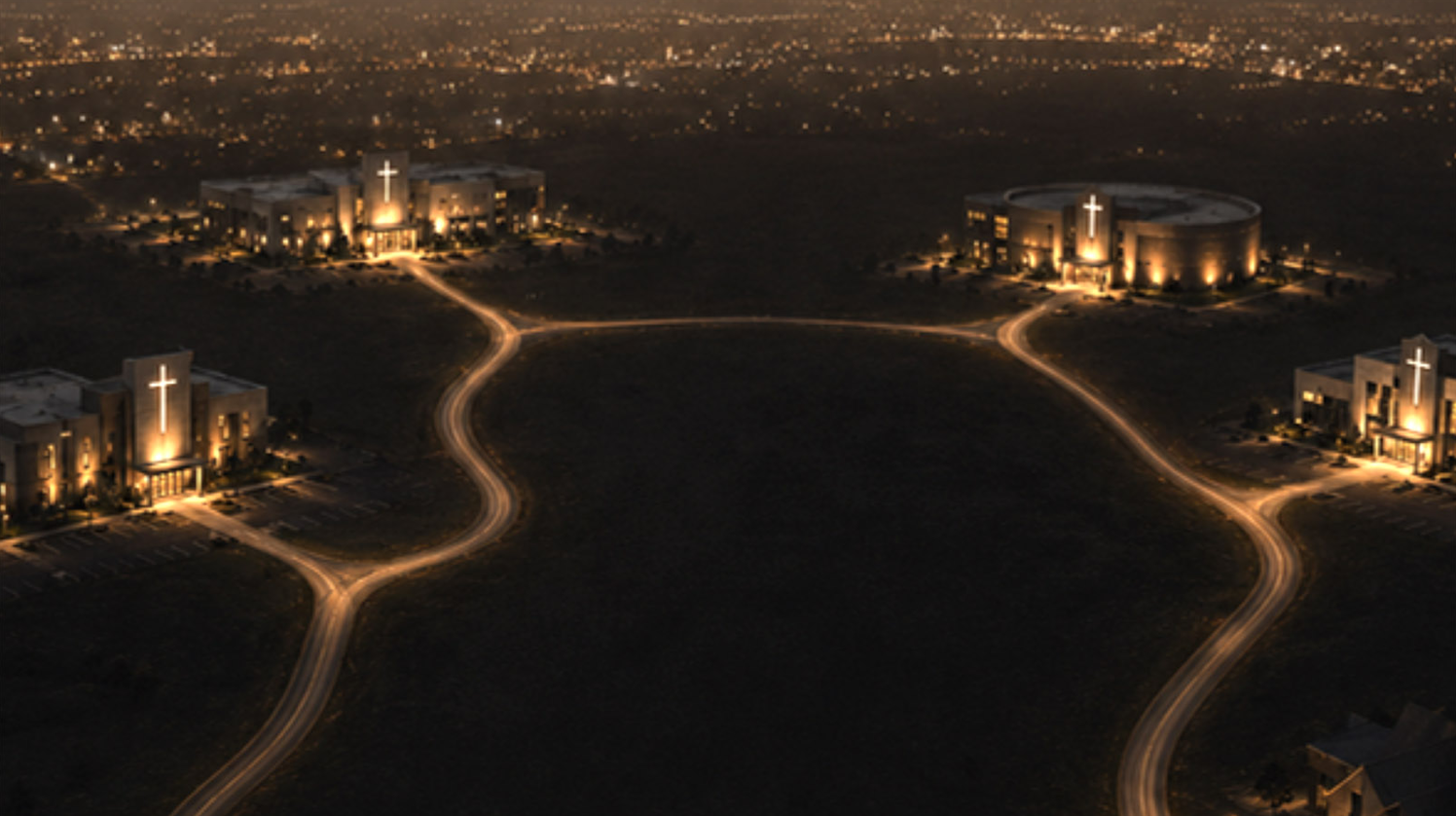

Image courtesy of The Ascent Leader
(RNS) — At least 5 million Americans attend a multisite church, where they often watch a video beamed in from another site and have access to all the advantages of a megachurch without the crowds.
The multisite movement, which started with a handful of large churches in the 1990s, is now relatively commonplace. An estimated 1,800 churches use that model nationwide, according to “Multisite Revealed,” a new report from The Ascent Leader, an evangelical leadership training group.
All told, those churches have about 6,000 local sites, known as campuses. And they are found in almost every state in the union.
“Where are multisite churches located?” Warren Bird, the lead researcher on the report, said during an online event Wednesday (Oct. 21) highlighting the report. “Everywhere but Wyoming.”
The report, which drew on survey responses from more than 1,000 church leaders, found that more than half (57%) of multisite churches, which are predominantly evangelical, are found in suburban settings. A quarter are in rural settings, while 18% are in urban areas.
Most of the country’s largest Protestant churches are multisite, including almost all those on the list of the top 25 largest congregations compiled by Outreach Magazine. The lone exception in that group is Lakewood Church, led by televangelist and author Joel Osteen, which meets in a former basketball arena in downtown Houston. (Resurrection United Methodist Church in Kansas, led by pastor and U.S. Senate candidate Adam Hamilton, ranks No. 89 on the Outreach list with just under 10,000 attendees and has six locations.)
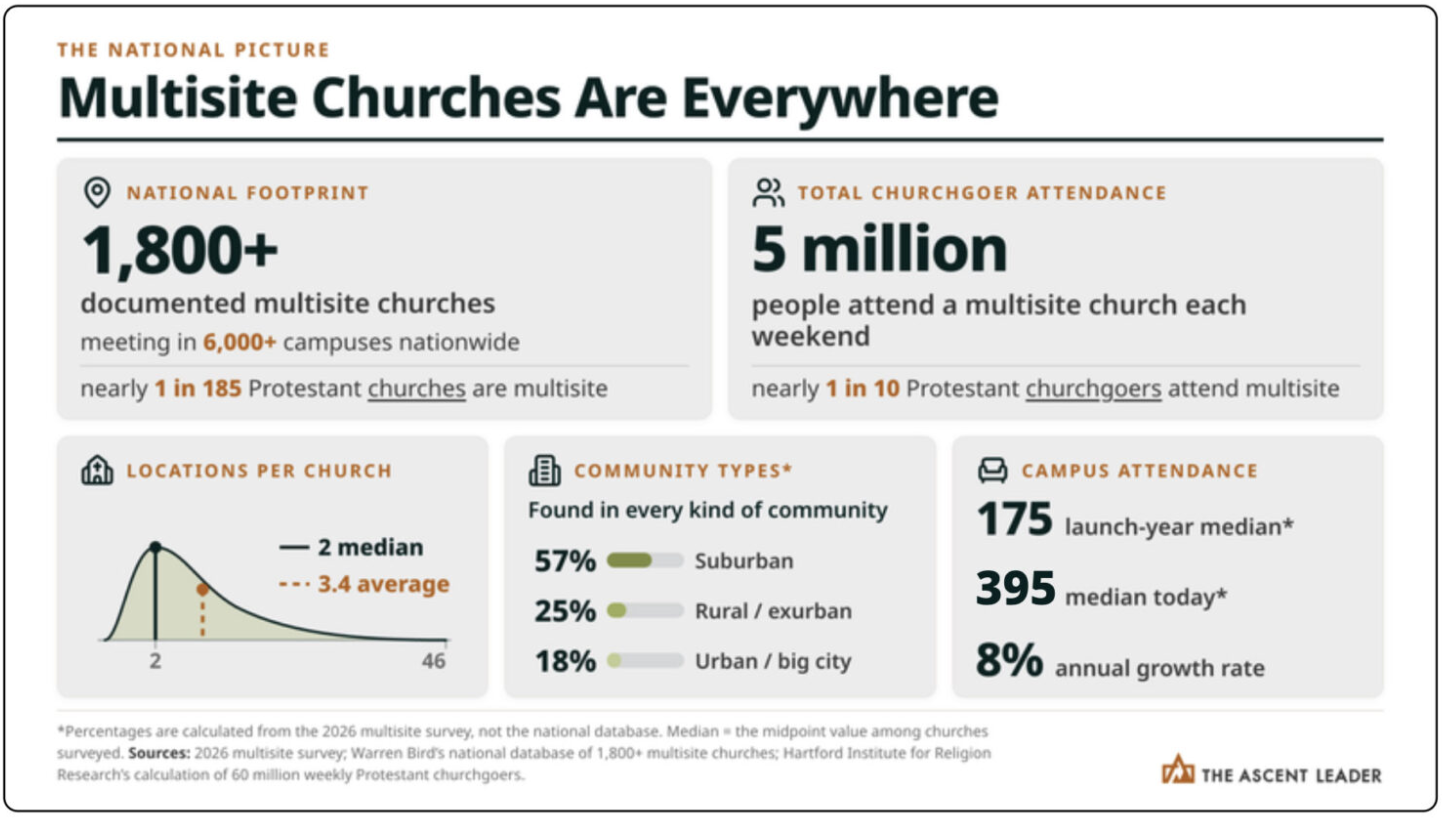
Graphic courtesy of The Ascent Leader
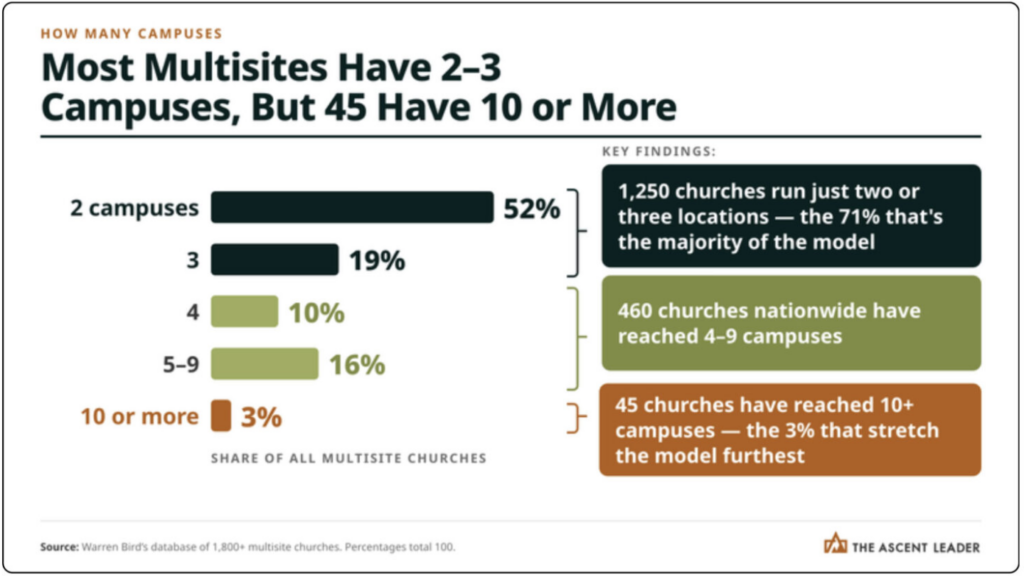
To qualify for the survey, churches had to meet in more than one location while sharing the same budget and leadership. Churches in the survey had an average of 3.4 campuses, and those campuses had a median attendance of 395 people. That makes those campuses larger than the median-sized U.S. church, which draws about 70 people to worship.
About half of the churches (52%) had two or three campuses. A few (3%) had 10 or more.
Bird said that churches in the survey aren’t all the same. About 4 in 10 are franchises, where every service is nearly identical and all decisions are made from the central office. A similar number use what researchers called a “federation model,” which all have the same branding and are led from a central office but aren’t identical. The rest have a “family model” with shared leaders but some local differences.
Researchers found that campuses for multisite churches are growing by about 9% each year, with faster growth (16%) happening in the first five years of a church’s existence.
“This research shows us that multisite has proven to be an effective and adaptable church reproduction model,” said author and consultant Jim Tomberlin, who co-authored the report.
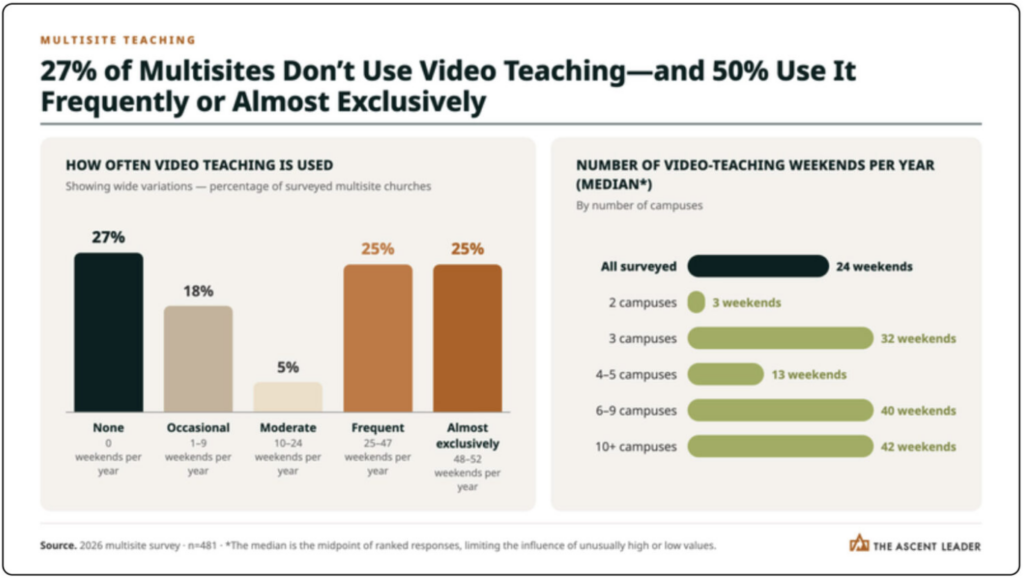
One of the most contested topics among multisite churches is whether they stream the sermon by video from a central location or have a live preacher in the building. Bird said researchers wanted to know if using video preaching, which is common in the largest multisite churches, remains commonplace.
Graphic courtesy of The Ascent Leader)
They found that about one in four (27%) multisite churches never use video preaching. Another 18% use it less than 10 times a year. About half of churches use video at least 25 weekends or more a year.
“Churches with just two campuses, which is half of all multisite churches, use little video teaching,” Bird said.
Almost all multisite churches (92%) use a team of preachers.
Among the biggest challenges for multisite churches is finding enough leaders and facilities for their campuses.
“What’s the most named challenge or obstacle in launching a new campus? In a word — it’s locating a suitable facility,” said Tomberlin. “Close behind is a leadership shortage.”
Graphic courtesy of The Ascent Leader.
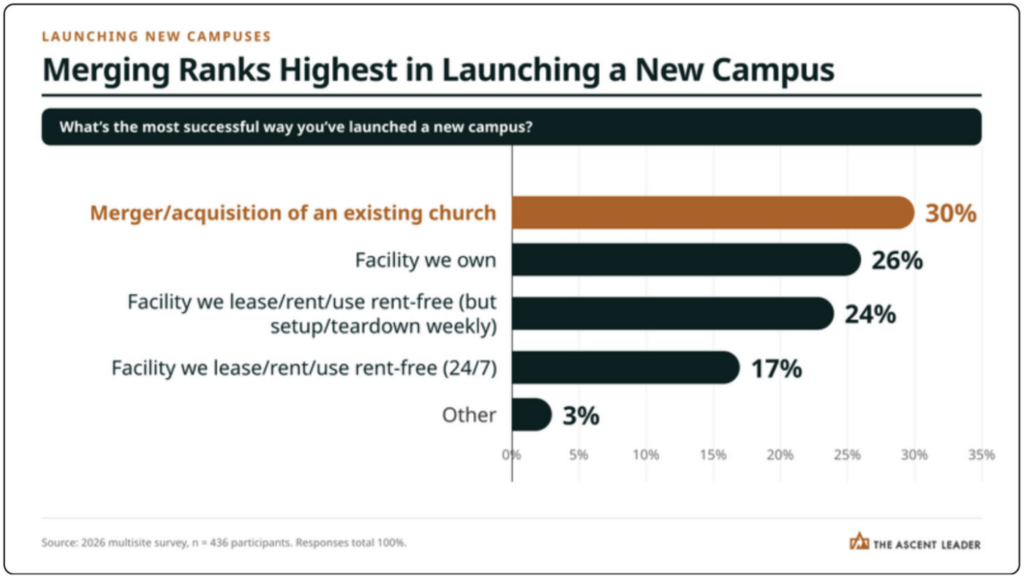
Between 30% and 40% of facilities were acquired in mergers between a larger church and a smaller church.
“Our survey findings underscored the reality that mergers are a prominent vehicle of multisite churches for campus expansion and for church revitalization,” Bird said.
Courtesy of The Ascent Leader.
A new campus costs about $1,250 per worshiper to start up, according to the report. Just over half become self-sufficient within three years.
About half the churches in the survey had started a new campus within the past three years. And researchers expect that trend to continue.
“The multisite movement is developing some serious wings,” Bird said.
Access to MinistryWatch content is free. However, we hope you will support our work with your prayers and financial gifts. To make a donation, click here.
TO OUR READERS: The mission of MinistryWatch is to help Christian donors become more faithful stewards of the resources God has entrusted to them. Do you know of a story that will help us fulfill our mission, or do you want to give us feedback about this or any other story? If so, please email us at [email protected].