
Mark Whitacre: From Corporate Scandal to a Life of Second Chances

In the early 1990s, Mark Whitacre appeared to have everything a young corporate executive could want: an Ivy League doctorate, wealth, prestige and a rapidly rising career at Archer Daniels Midland. By age 32, he was president of ADM’s BioProducts division, and by 35 he was a corporate vice president and a candidate to become the company’s president.
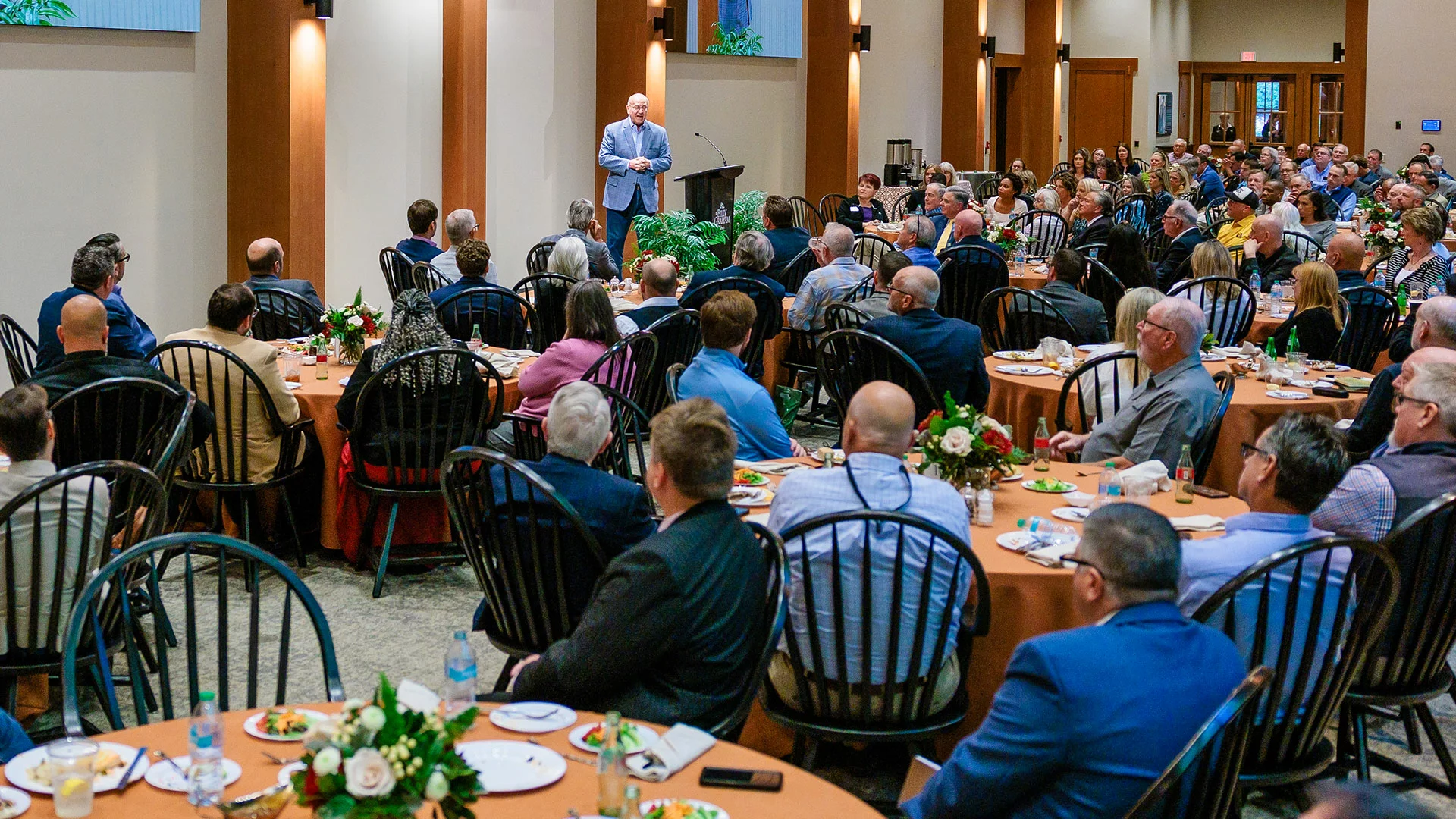
Mark Whitacre speaking / Photo courtesy of The Billy Graham Library
Then his life unraveled.
Whitacre’s extraordinary story was dramatized in a (not so extraordinary) 2009 movie “The Informant!”, starring Matt Damon. But the film omitted what Whitacre considers the most important chapter of his life: his conversion to Christianity while serving a lengthy federal prison sentence.
A better account of Whitacre’s life emerged in Marvin Olasky’s 2009 interview with Whitacre at The King’s College for WORLD. It was an event I helped organize, and wrote about, so I was delighted to reconnect with Whitacre on Friday when he spoke at the Billy Graham Center in my hometown of Charlotte.
Whitacre earned his Ph.D. in nutritional biochemistry from Cornell University in 1983. He joined ADM in 1989 after working for Ralston Purina and the German chemical company Degussa. He quickly rose through ADM’s ranks.
But the ambition that fueled his rise also contributed to his downfall.
ADM was involved in an international price-fixing conspiracy involving lysine, an animal-feed additive. Whitacre secretly cooperated with the FBI. He wore listening devices and made hundreds of recordings that helped expose the conspiracy. The Justice Department later said Whitacre made more than 120 tapes and met with FBI agents more than 150 times during the investigation.
The subsequent trial made national news and resulted in several top ADM officials going to jail. The company had to pay more than $100 million in fines and penalties. ADM customers sued, recovering hundreds of millions more. It was the largest case of its kind in American history.
Yet Whitacre was not simply the heroic whistleblower portrayed in some accounts. While cooperating with the FBI, he was also stealing money from ADM. He eventually admitted taking nearly $9 million through fictitious companies, phony invoices and foreign bank accounts. The Justice Department charged him with wire fraud, money laundering, tax-related offenses, and other crimes.
Whitacre later said his thinking had become distorted by his sense of entitlement. “I looked at it as paying myself,” he told Olasky. He regarded himself as the person exposing a billion-dollar crime and convinced himself that taking millions from ADM was justified.
His wife, Ginger, played a pivotal role. When Whitacre hesitated to tell the FBI everything he knew, she confronted him. Eventually Whitacre became the highest-ranking U.S. corporate executive to become an FBI whistleblower.
The consequences were devastating. Whitacre was convicted in the ADM price-fixing case and separately pleaded guilty to fraud charges. He spent more than eight years in federal prison.
At first, he was overwhelmed by shame, fear and the loss of everything he had built. In the WORLD interview, and at the Billy Graham Library last Friday, he said he “did not want to live” and attempted suicide.
Prison, however, became the setting for a profound change.
During a transfer through an Atlanta federal facility, Whitacre began reading the Bible, particularly the Psalms. “That’s when I started really relying on God,” he said. He had attended church before his imprisonment and considered himself a Christian, but he came to distinguish that earlier religious identity from the dependence on God he experienced in prison.
Chuck Colson, the former Nixon aide who became a Christian after his own Watergate conviction and founded Prison Fellowship, became one of Whitacre’s mentors. Whitacre has since said that Colson helped him understand grace, responsibility and servant leadership.
Rather than simply waiting for his sentence to end, Whitacre began discipling other prisoners and helping some obtain GEDs and college credits. He later described his imprisonment as the most productive period of his life.
Whitacre was released in December 2006. The next day, he began work at Cypress Systems, a California biotechnology company. He subsequently became deeply involved in the Christian faith-and-work movement, serving as national director and then chief operating officer of Christian Business Men’s Connection from 2013 to 2019.
In 2019, Whitacre joined Charlotte-based Coca-Cola Consolidated, a publicly traded company led by Frank Harrison, who also spoke on Friday and who is himself a well-known Christian business leader and philanthropist.
Whitacre now serves as Vice President of Culture & Care and executive director of the company’s “t-factor initiative,” which seeks to help businesses develop purpose-driven cultures. The initiative grew out of Coca-Cola Consolidated’s effort to integrate faith, servant leadership and corporate culture. Its stated purpose is “to transform workplace cultures around the world for good, for God, for growth.”
On Friday, Whitacre retold his story, but for me it had a deeper resonance than when I first heard it in 2009. When I first met Mark Whitacre, just a few years out of prison, while he was promoting a new book and movie, I worried that the “Evangelical Industrial Complex” was doing what it had done too many times before: promoting a new Christian with a sensational story to a big platform — later to see him and his platform collapse under the weight of his own celebrity and the shallow roots of his Christian faith.
But now, 20 years after Whitacre’s release from prison, Whitacre’s testimony has been “road tested.” His story has a ring of authenticity that only decades of faithful service can produce.
For Whitacre, the central message was not the remarkable corporate scandal that made him famous, nor even the Hollywood movie that told part of his story. It is redemption.
“I thank God for second chances,” he said at the Billy Graham Library.
“I know that this could sound like a cliché,” Whitacre said 17 years ago at The King’s College, and echoed on Friday, “but the only difference between ‘bitter’ and ‘better’ is the letter ‘i.’ My experiences could have made me bitter, but they haven’t. They’ve made me better, but only because I finally learned that it’s not all about me.”
TO OUR READERS: The mission of MinistryWatch is to help Christian donors become more faithful stewards of the resources God has entrusted to them. Do you know of a story that will help us fulfill our mission, or do you want to give us feedback about this or any other story? If so, please email us at [email protected].