


Federal Cyberstalking Case Raises Questions About Church Security
A case in New York highlights a potential threat churches can face from within.

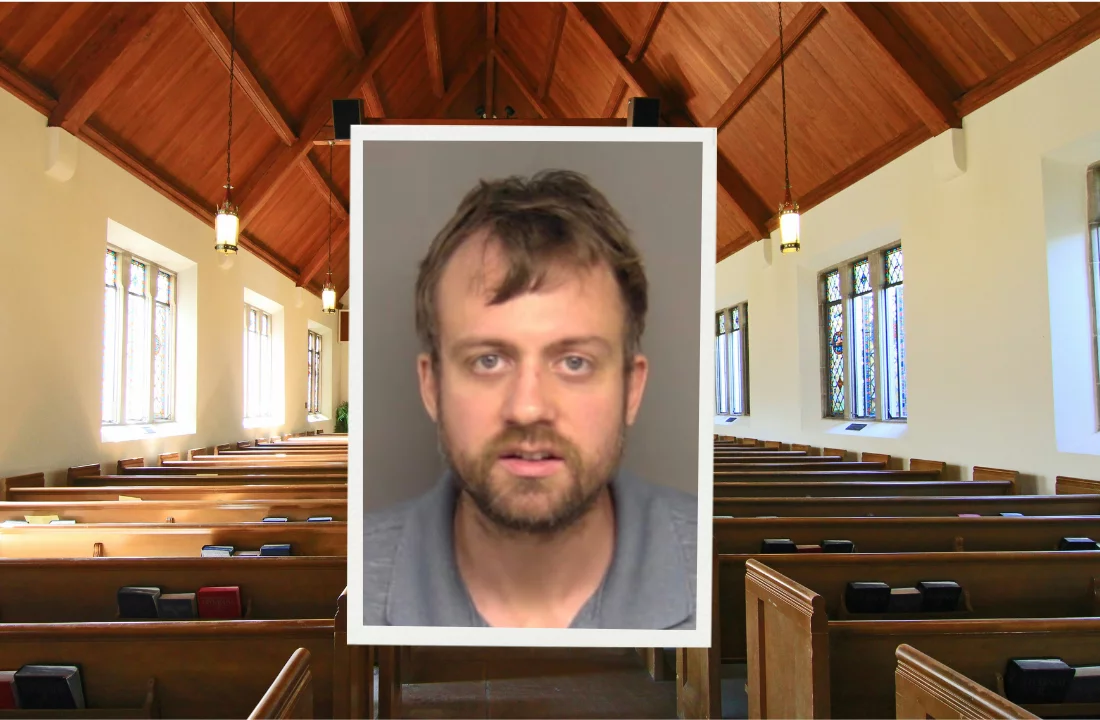
A Michigan man was banned from a New York church after he was found to be repeatedly harassing the pastor and two female congregants.
Church interior photo by Debby Hudson (Unsplash) / Insert of Phillip Bonneville
Phillip Bonneville, 30, of Macomb, Michigan, faces a federal charge of cyberstalking. He attended the Ithaca, New York, church while a Ph.D. student at Cornell University, according to WDIV in Detroit.
The allegations illustrate the difficult decisions churches increasingly face when a congregant’s behavior escalates from concerning to threatening — questions about when to bar someone from church property, involve law enforcement, and protect worshippers while maintaining a welcoming environment.
A woman said she befriended Bonneville while attending church in 2021. After she moved away, he allegedly began sending her increasingly disturbing emails, first expressing romantic interest and later making violent statements. He also requested a welfare check on her despite knowing she had relocated, prompting police to recommend she seek a restraining order.
In January 2023, Bonneville allegedly confronted the woman twice at a campus ministry event. She secured a no-contact order, and campus ministry leaders told Bonneville not to attend any ministry events.
The following month, the church elders barred Bonneville from attending the church unless he sought mental health treatment. The situation appeared to subside temporarily after Bonneville faced criminal charges for alleged harassment.
But in March 2024, Bonneville allegedly began sending hundreds of emails to the pastor and elders, accusing the pastor of abuse and of “secret homosexuality.” Investigators say he resumed communication with the woman after her no-contact order expired and threatened to attend a church worship service to protest the pastor.
In September 2024, after more harassing behavior, the church barred Bonneville from its property — but the alleged harassment continued.
Over the following year, investigators say Bonneville sent increasingly threatening emails to the pastor and contacted the Presbyterian Church in America headquarters, warning that “God is immensely angry with this teaching elder and church” and that he was planning “something very dramatic” at the denomination’s General Assembly.
He also allegedly told the pastor he would attend the General Assembly in Chattanooga, Tennessee, in June 2025. Deputies located him, searched him for weapons, and asked him to leave.
After he again allegedly threatened to attend and then appeared at the 2026 General Assembly in Louisville, Kentucky, federal authorities obtained an arrest warrant on June 25, 2026.
The case illustrates the steps churches are advised to take when troubling behavior escalates — from restricting attendance to involving law enforcement.
The Family Research Council tracked incidents of violence at churches since 2018. It reports 1,384 acts of hostility against churches between 2018 and 2024.
In a widely reported incident, anti-ICE protestors interrupted Sunday morning worship at Cities Church in St. Paul, Minnesota in January 2026, prompting the church to consider its legal options.
Access to MinistryWatch content is free. However, we hope you will support our work with your prayers and financial gifts. To make a donation, click here.
Advice for Churches
In Bonneville’s case, the church leaders prohibited him from attending worship services, urged him to seek mental health treatment, and eventually barred him from the church property altogether. According to safety and security guidance from the Alliance Defending Freedom (ADF) Church and Ministry Alliance, churches have the legal authority to ask a disruptive person to leave church property.
ADF also recommends that churches have a security plan designating which staff and volunteers will handle disruptions and call law enforcement if necessary.
ADF does not draw a bright line for when to contact law enforcement but advises that police should be called if congregants’ safety is in question.
ADF also recommends establishing good relationships with local law enforcement before a crisis occurs, noting the relationships can be “immensely valuable amidst the range of potential disruptions or situations.” In the Bonneville case, local law enforcement became involved to help resolve the safety concern.
Many churches appear to be taking safety threats seriously. According to a 2023 Lifeway Research study, about 81% of Protestant pastors in the U.S. say their church has some kind of safety measures in place.
“Churches are not immune to violence, disputes, domestic disagreements, vandalism and burglary,” said Scott McConnell, executive director of Lifeway Research. “While loving one another is a core Christian teaching, churchgoers still sin, and non-churchgoers are invited and welcomed. So real security risks exist whether a congregation wants to acknowledge them or not.”
MAIN PHOTO: Church interior photo by Debby Hudson (Unsplash) / Insert of Phillip Bonneville
TO OUR READERS: The mission of MinistryWatch is to help Christian donors become more faithful stewards of the resources God has entrusted to them. Do you know of a story that will help us fulfill our mission, or do you want to give us feedback about this or any other story? If so, please email us at [email protected].