
Eight Leaders of House of Prayer Christian Church in GA Indicted for Fraud
The leader used a stolen identity.

Leaders of the House of Prayer Christian Church in Hinesville, Georgia, were indicted on federal fraud and tax charges for allegedly defrauding banks through real estate schemes and funneling veterans’ benefits to its seminary.
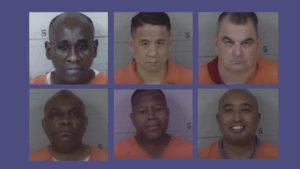
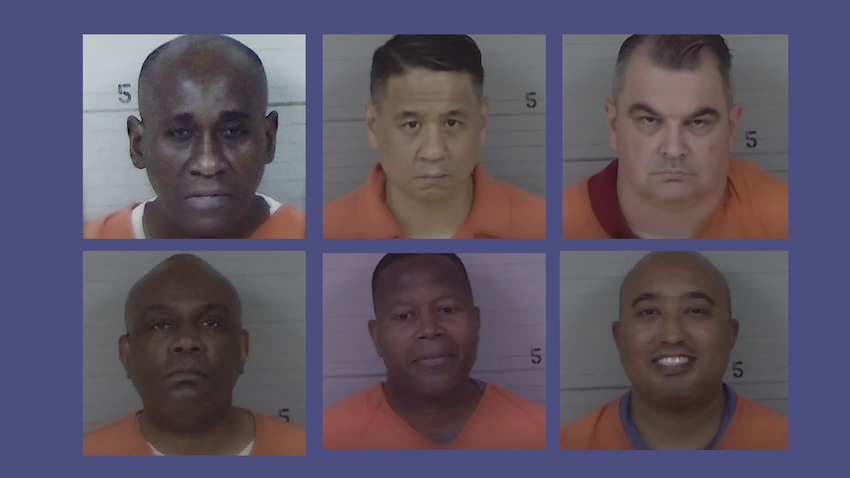
Six of the HOPPC defendants; Top, from left to right: Rony Denis, Anthony Oloans, David Reip; Bottom, from left to right: Joseph Tyrone Fryar, Gerard Robertson, Marcus Labat / Photos via HOPCC support group
The indictment, unsealed on September 10, revealed that eight men associated with the church were charged with various crimes, including conspiracy to commit bank and wire fraud and assisting in filing a false tax return.
The leader is identified as Rony Denis, an identity he apparently stole in 1983 then used to become a U.S. Citizen in 2002.
Additional defendants include Anthony Oloans, Joseph Fryar, Dennis Nostrant, Gerard Robertson, David Reip, Marcus Labat, and Omar Garcia.
“The defendants are accused of exploiting trust, faith, and even the service of our nation’s military members to enrich themselves,” Paul Brown, Special Agent in Charge of FBI Atlanta, said in a press statement. “This indictment makes clear that using coercion, manipulation, and fraud under the guise of religion will not shield wrongdoers from accountability.”
Denis and his fellow defendants allegedly used their leadership positions to exert extreme control over congregants, by manipulating them into turning over personal information, pressuring them into marriages and divorces arranged by church leaders, and forcing them to live in properties so as to generate rental income for the defendants.
They also allegedly maintained a list of “ex-HOPCC traitors,” humiliated members for perceived rule violations, and restricted contact with family members who left the church, according to the indictment.
From 2004 to the present, the defendants engaged in a conspiracy to defraud financial institutions, the Department of Justice said. They recruited persons to serve as “straw buyers” of real estate, concealing the buyers’ true identity, then used falsified documents like loan applications, closing documents, and powers of attorney, to acquire and transfer property.
They would then convert these acquired properties into rental homes, through which the defendants collected more than $5.2 million in rental income between 2018 and 2020.
The scheme benefited the defendants while leaving some of the “straw buyers” with damaged credit and foreclosures.
Access to MinistryWatch content is free. However, we hope you will support our work with your prayers and financial gifts. To make a donation, click here.
Defrauding Veterans of Education Benefits
The conspirators also allegedly defrauded military veterans and the U.S. Department of Veterans Affairs out of millions of dollars in benefits.
Even though it was ineligible to receive federal benefits because of its religious exemption, the House of Prayer Bible Seminary applied for and received more than $3 million in education benefits for its Georgia locations and more than $23.5 million for all five locations.
From 2013 through 2021, seminary officers allegedly submitted false certifications to Georgia regulators that claimed the seminary did not receive federal funds, despite receiving millions in veteran benefit payments each year.
While the conspiracy funneled veteran benefit money into the seminary and church accounts, enriching the defendants, it exhausted some veterans’ benefits, often without allowing the students to complete their programs of study.
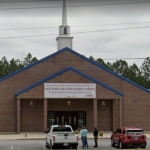
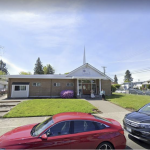
According to reporting by WSAV, the House of Prayer Christian Church’s headquarters is in Hinesville, Georgia, but it has other locations outside of military bases in Georgia, Washington, Texas, North Carolina and California.
The HOPCC website shows a video of the FBI raiding the church in 2022.
“It was cult, at its core it was a cult that was a real estate/[Veterans Affair] scam,” Taiana Moreno, a former member of the church, told WSAV.
She left the church in 2021, but said she was always pressured to give money during her time there.
“Over the process of time, they were just demanding more and more money out of us, and they were funding all these so-called missionary trips and asking for the members to constantly donate,” Moreno said. “My ex-husband was giving money, like all the time, just so much money and offerings.”
On September 10, a federal grand jury indicted Bernadel Semexant, a pastor connected to the House of Prayer Christian Churches of America, for various sex offenses involving a minor, according to a Department of Justice press release.
The 34-year-old pastor is accused of enticement of a minor to engage in sexual activity, sexual abuse of a minor, transfer of obscene material to a minor, receipt of child pornography and possession of child pornography.
Semexant’s offenses carry sentences of between 10 and 20 years in prison along with fines.
The conspiracy offenses carry maximum prison sentences of up to 30 years and fines up to $1,000,000.
The FBI is asking for any other victims of the House of Prayer Christian Church conspiracy or of Semexant to reach out via the FBI website at fbi.gov/HOPCCVictims.
TO OUR READERS: The mission of MinistryWatch is to help Christian donors become more faithful stewards of the resources God has entrusted to them. Do you know of a story that will help us fulfill our mission, or do you want to give us feedback about this or any other story? If so, please email us at [email protected].
EDITOR’S NOTE: Why does MinistryWatch report on financial fraud in the church? We report on them because one in three churches will be victimized, according to the Center for the Study of Global Christianity. We also report on them because these crimes have real victims and cost taxpayers and other stakeholders billions of dollars every year. Even small crimes in small churches have huge consequences. We also report on them to remind our readers that they do not have to be victims. There are steps you can take to prevent financial waste, fraud, and abuse in your church or ministry. To find out more, click here.