
Southern Baptist Pastor Pay Stagnant Since 2024
Other church staff saw pay gains, but most pastors still lack employer-funded health coverage.

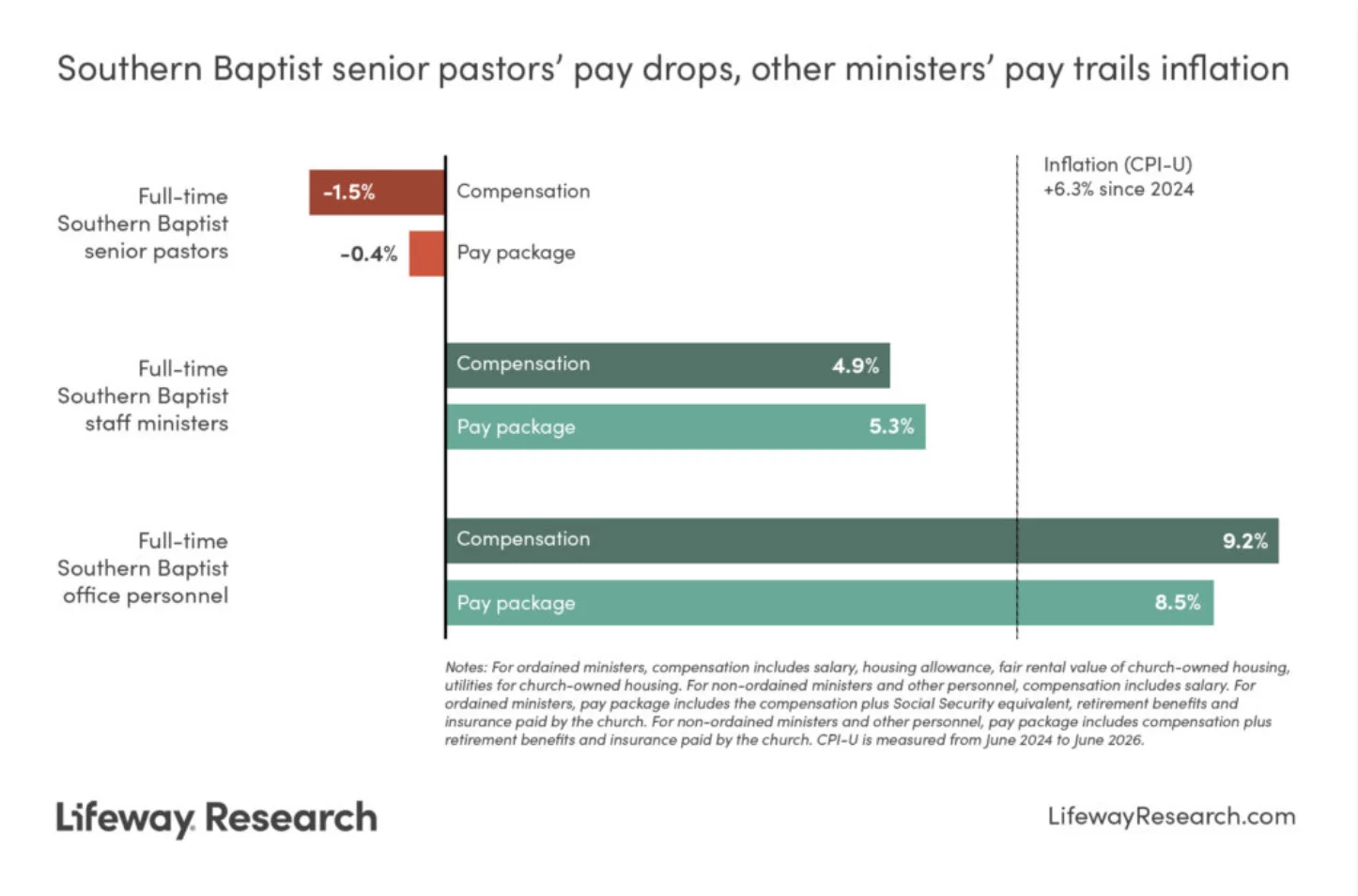
BRENTWOOD, Tenn. — Senior pastors at Southern Baptist churches have had to make do with less pay and even less purchasing power recently.
Compared to two years ago, the average Southern Baptist pastor’s pay package and total compensation have decreased while inflation continues to rise, according to a study conducted by Baptist state conventions along with Lifeway Research and GuideStone Financial Resources.
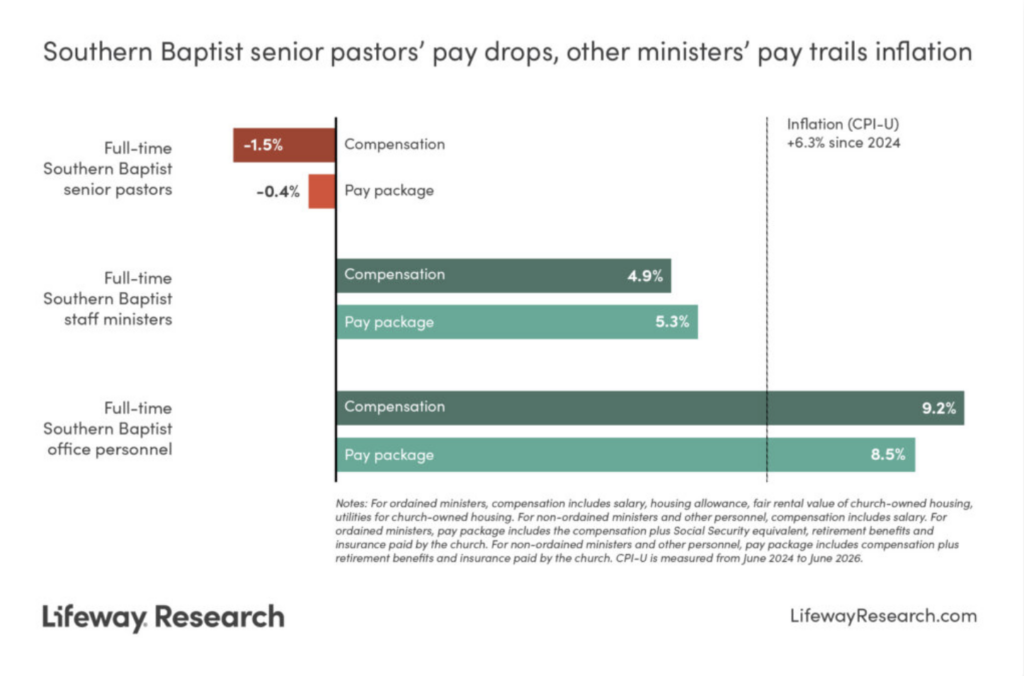
The Consumer Price Index (CPI), the most widely used measure of inflation, grew 6.3 percent since 2024. Yet, the average compensation for full-time senior pastors fell 1.5 percent, and the average pastor’s total pay package dropped 0.4 percent over the same period.
While still trailing inflation, other full-time staff ministers saw average increases in their compensation (4.9 percent) and pay package (5.3 percent). Among full-time church staff, only the office personnel saw their salary (9.2 percent) and total pay package (8.5 percent) outpace inflation.
“Many churches are feeling the financial pressure of having a smaller number of active members than before COVID,” said Scott McConnell, executive director of Lifeway Research. “Some pastors may be bearing the consequences of churches barely affording a full-time pastor. There will be increased pressure for some of these smaller church pastors to take on a second job to make ends meet.”
This marks the first time both the pay package and compensation for senior pastors have decreased since Lifeway Research began surveying Southern Baptist pastors on this topic in 2008. Coming out of the pandemic in 2022, compensation had slightly increased since 2018 (0.2 percent) while the pay package fell 2.1 percent.
Access to MinistryWatch content is free. However, we hope you will support our work with your prayers and financial gifts. To make a donation, click here.
“Healthy churches and healthy pastors go hand in hand,” said Hance Dilbeck, president and CEO of GuideStone. “When a church thoughtfully invests in the compensation and well-being of its pastor, it is investing in the long-term effectiveness of its ministry. Fair and appropriate compensation can help reduce unnecessary financial pressures, strengthen a pastor family’s resilience, and provide greater freedom to focus on the ministry to which he has been called.”
Despite the recent decline for senior pastors, pay and benefits for all church staff have kept up with or exceeded inflation over the past four years. While the CPI increased 12.7 percent since 2022, senior pastor compensation (14.9 percent) and pay package (13.4 percent), other staff minister compensation (12.7 percent) and pay package (13.5 percent) and full-time office personnel compensation (20.3 percent) and pay package (20.9 percent) have all grown by at least the rate of inflation.
Budget numbers
Since 2018, churches have spent a similar percentage of their budget on employee compensation and benefits. Currently, the average Southern Baptist congregation spends 45 percent of its budget on personnel.
In general, the larger the church, the higher the median budget percentage dedicated to employees. The smallest Southern Baptist congregations, fewer than 50, expend a median of 42 percent of their spending on personnel. That grows to 46 percent for churches with 50 to 99 in attendance and 47 percent in those with 100 to 249. The largest churches, 250 or more, spend half (50 percent) their budget on employees.
“Not only are lay people increasingly drawn to larger churches, but so are ministers. Larger churches pay senior pastors more and have more paid staff,” said McConnell.
The average Southern Baptist pastor has been working in a church vocation for 22 years and serving at his current church for 10.
Benefits often not included
Most Southern Baptist congregations (63 percent) do not provide medical insurance for their senior pastor. More than a third pay for insurance, including 18 percent for the pastor and his family, 11 percent for the pastor and his wife and 9 percent for the pastor only.
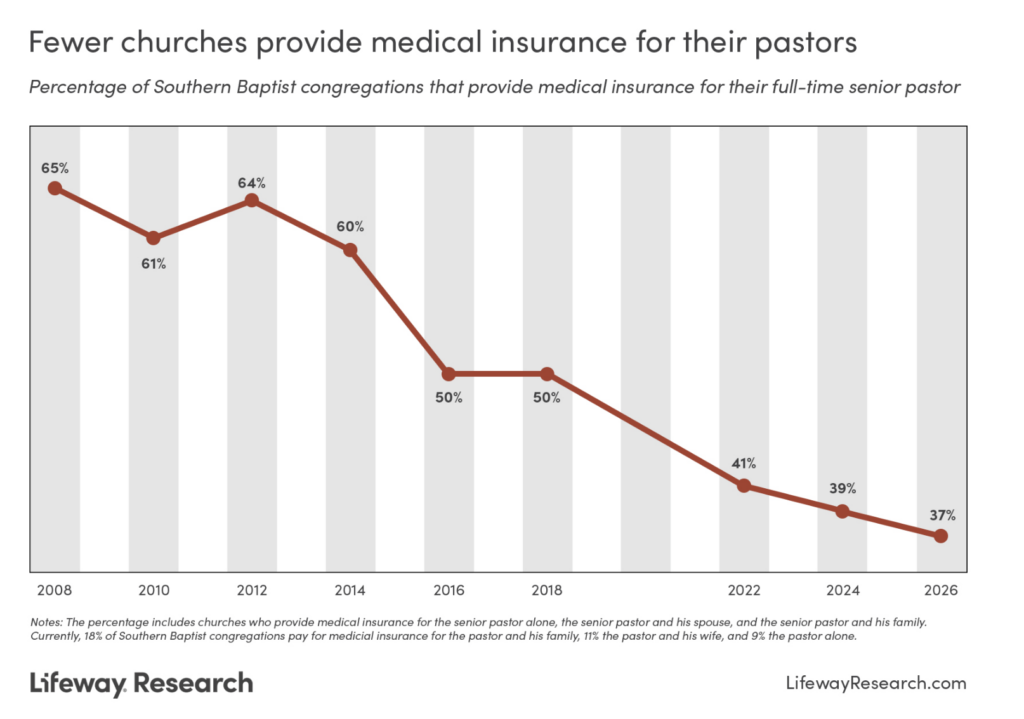
The percentage of churches paying for this benefit has been declining over the past two decades. In 2008, 65 percent of Southern Baptist congregations funded medical insurance. The share fell to half by 2016, before reaching 37 percent in 2026.
The larger the church, the more likely they are to provide insurance for their senior pastor. Around 1 in 4 churches with fewer than 50 in attendance (26 percent) provide medical insurance for at least the pastor. For those congregations with 50 to 99 attendees, more than a third (36 percent) cover that cost. Almost half (46 percent) of pastors of churches between 100 to 249 have church-funded medical insurance, while two-thirds (67 percent) of those leading churches of 250 or more receive that benefit.
Fewer Southern Baptist congregations provide additional types of insurance: 20 percent life and/or accident coverage, 20 percent dental, 17 percent disability and 14 percent vision. Again, the larger the church, the more likely they are to pay for these benefits for their senior pastor.
“Through the years, medical insurance expenses have grown faster than inflation. As a result, many churches simply stopped providing insurance benefits,” said McConnell. “When it comes to paying for healthcare, many ministers are forced to walk by faith.”
Factors in pay
Additional analysis of the compensation data reveals variables that contribute to the likelihood of increased pay for a senior pastor at a Southern Baptist church. Each dollar amount increase represents the average compensation change for a pastor.
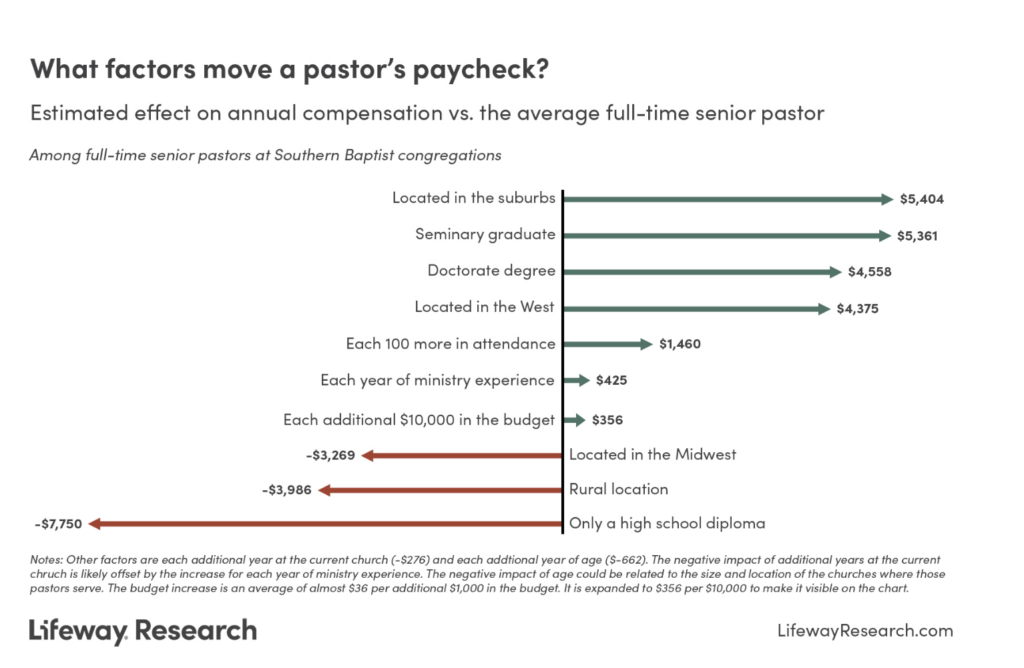
More people in the pews and dollars in the budget likely leads to a higher salary. Each additional attendee adds $15 to the annual compensation, while pastor pay increases $36 for every $1,000 the church budget increases.
Increased ministry experience also plays a role. Every year a pastor has been in a church vocation leads to a $425 annual increase.
The education level of a pastor is also a factor but not for every level. Those who have only a high school diploma bring home $7,750 less each year than the average Southern Baptist pastor. Those whose highest level of education is an associate, bachelor’s or master’s degree see no impact from each of these accomplishments. However, a seminary graduate makes $5,361 more, while a pastor with a doctorate earns $4,558 more.
Those at churches in the Midwest earn $3,269 less than the overall average, while those in the West make $4,375 more. Additionally, those in a rural context earn $3,986 less, but those in a suburb make $5,404 more.
Vacation time
The average Southern Baptist senior pastor receives almost 15 days of vacation each year, with the project model starting with a baseline of 13 days. As with pay, some variables lead to an increase or decrease for this benefit. Based on the expected vacation impact for age, ministry experience and time at the current church, it takes about 10.4 years to add a day to the expected vacation time.
Larger churches offer more time away from the office for their pastors. For every 174 attendees, pastors gain one more vacation day on average.
As education increases, so does vacation time. On average, graduating from college adds 1.3 days, earning a master’s degree 2.6 days and a doctorate 3.4.
Churches in the Midwest tend to offer more vacation than average (1.2 days), while pastors in a rural context receive fewer (-1.7 days).
“While typical amounts of vacation for pastors sound good to many Americans, the rhythm of needing a sermon ready for each Sunday worked can necessitate working extra to make up for days off,” McConnell said. “Pastors should be encouraged to take all of their vacation and to plan it well to maximize rest.”
“We hope these findings give church leaders a helpful starting point as they make decisions that strengthen both their pastors and their congregations,” said Dilbeck.
For more information, view the complete study report and the regression report, and visit the online compensation tool.
Methodology
The 2026 Southern Baptist Church Compensation Study was conducted by Baptist state conventions along with GuideStone Financial Resources and Lifeway Research. The study was conducted between April 29 and June 29, 202L6. Data acquired by the study can be accessed at LifewayResearch.com/compensation-data. Responses from 3,888 full-time senior pastors, staff ministers and office personnel were used in this report. Responses for senior pastors were weighted by average attendance to more accurately reflect the population. Responses from 2,155 full-time senior pastors were used for the regression analysis.
This article was originally published by Lifeway Research.
TO OUR READERS: The mission of MinistryWatch is to help Christian donors become more faithful stewards of the resources God has entrusted to them. Do you know of a story that will help us fulfill our mission, or do you want to give us feedback about this or any other story? If so, please email us at [email protected].