‘Little Platoons’ Have Become a Powerful Army
Celebrating 10 years of The Colson Center for Christian Worldview

I first heard the expression “little platoons” from Chuck Colson, in a meeting in 2012, just weeks before his death. During the four years I spent at The Colson Center (2015–2019), we used that expression a lot.
Photo via Facebook @Colson Center
If you have never heard that expression before, let me explain where it came from and what it means.
The expression did not, in fact, originate with Chuck. Its first use comes from the Anglo-Irish political philosopher and statesman Edmund Burke (1729–1797). It appears in his 1790 work “Reflections on the Revolution in France.” Burke wrote: “To be attached to the subdivision, to love the little platoon we belong to in society, is the first principle … of public affections.”
Burke’s point was that people’s loyalties and responsibilities begin with the institutions closest to them — family, church, neighborhood, voluntary associations, local charities, and civic groups.
These “little platoons” teach virtue, responsibility, and social trust, and they serve as a buffer between the individual and the centralized state.
In the 20th century, the phrase was revived and popularized by conservatives such as Russell Kirk and Robert Nisbet — and Chuck Colson. They argued that healthy societies depend on strong mediating institutions rather than relying solely on government or the market.
In fact, the idea of “little platoons” was a guiding principle of the book “Restoring All Things,” the book I co-wrote with Colson Center President John Stonestreet. We wrote: “The true strength of a society…comes from its ‘middle,’ in those activities and institutions that exist between the individual and the government.”
Access to MinistryWatch content is free. However, we hope you will support our work with your prayers and financial gifts. To make a donation, click here.
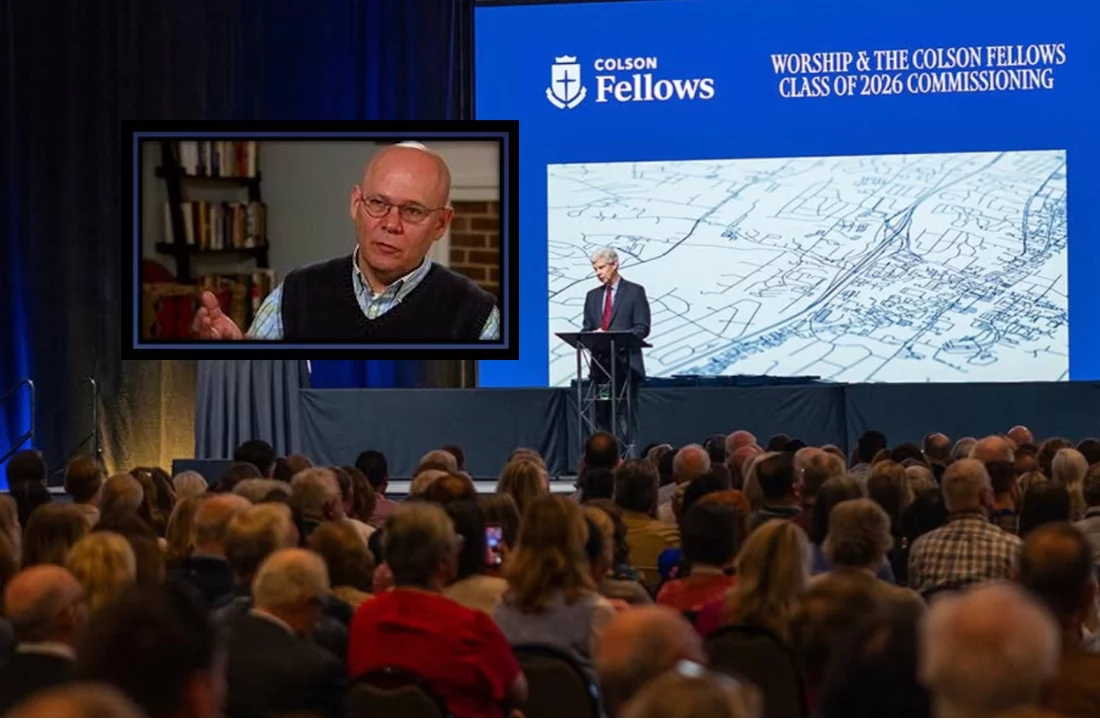
Last month, The Colson Center celebrated 10 years of ministry with its national conference in Knoxville, Tennessee. Since I had been there at the beginning in 2016, I wanted to be there for this milestone. I am glad I was. I got to see what happens when hundreds of those “little platoons” come together. What I saw was the beginnings of a powerful army.
More than 2,400 people gathered in Knoxville, but one of the things that stood out to me was not that this gathering has grown to become one of the largest Christian conferences in the country, but that it has retained its “little platoon” feel. The Colson Center, through its Colson Fellows program, now has 95 regional, online, and international cohorts, as well as 133 church affiliate cohorts, hosted by congregations across North America and beyond. These 200-plus cohorts have about 1,800 participants — roughly eight to 10 people per group. Each year, when they graduate (as a group did in Knoxville) they join a cadre of more than 7,000 Colson Fellows who have been commissioned to date.
The conference in Knoxville was not just a commissioning ceremony for this year’s class of Fellows; it was also a gathering for many who have been commissioned in the past and who have now assumed leadership in their local communities. In fact, producing a three-year plan for implementing the principles of the Fellows program in your local church or community is a requirement of the program. This makes the Colson Fellows program unique, in my view. It is not merely an educational program, or a one-time event. Much education happens, and there are one-time events, such as this national conference. But the Fellows program also provides an environment for faith formation, community, and hands-on service to the local church.
Michael Craven is Dean of the Colson Fellows Program. He said, “The growth of the Colson Fellows program reflects an increasing hunger among Christians for deeper spiritual formation, a more comprehensive understanding of the Christian worldview, and faithful discipleship in every sphere of life.”
The Colson Educators program, one of the Colson Center’s newest programs, now equips teachers to integrate a Christian worldview throughout their teaching. It has served more than 36,000 Christian educators since its launch. During the 2026–2027 academic year, educators at more than 30 schools will participate in a 10-month formation experience designed to cultivate intellectual and spiritual formation.
It was an honor for me to play a very small role in the founding of The Colson Center. I know pride is not a biblical virtue, but I will be transparent and admit to a bit of pride at what a small band of us, with God’s help, birthed a decade ago. That feeling was, however, quickly replaced by awe and humility by seeing the competence of the current team, and what The Colson Center has become.
“Chuck Colson knew that Christianity is not merely a set of private beliefs, but truth that speaks to every area of life,” John Stonestreet said. “The Colson Center exists to carry that vision forward by helping Christians understand their faith, live it confidently, and engage the world with wisdom and conviction. We give thanks to God for His faithfulness over the past decade and remain committed to serving the Church for generations to come.”
Based on what I have seen, Chuck’s vision is already coming to pass.
TO OUR READERS: The mission of MinistryWatch is to help Christian donors become more faithful stewards of the resources God has entrusted to them. Do you know of a story that will help us fulfill our mission, or do you want to give us feedback about this or any other story? If so, please email us at [email protected].