
5 Reasons to Comply With ECFA’s New Standard
Five powerful fraud prevention reasons, based on biblical principles, all ministries should embrace to comply with the new leader care standard.

OPINION—On March 6 2024, the ECFA (Evangelical Council for Financial Accountability) announced the introduction of a new standard No. 8, also known as the Excellence in Leader Care standard, a significant update to its accreditation standards for responsible stewardship since the late 1970s. All ECFA members are required to adopt this new standard by January 2027.

Excellence in Leader Care Standard – “Every organization’s board and senior leader shall work together to develop a care plan for the senior leader. The plan shall be approved annually by the board to demonstrate the organization’s commitment to caring proactively for the leader’s well-being and integrity.”
Even though initially 94% of ECFA’s members agreed that integrity failures have an impact on ministry trust, ECFA membership has started slightly declining ever since the new standard was announced.
In 2025, there was a net ECFA membership contraction of 14 members (or 0.5% of its total membership), which is a reversal of its average annual membership growth of 2% in recent years. One of the most significant membership resignations included the Billy Graham Evangelical Association, Samaritan’s Purse, and Columbia International. In a controversial letter dated July 2, 2025, Franklin Graham, President and CEO of Samaritan’s Purse, said, “After much consideration, and in light of our conviction that ECFA has inappropriately ventured outside its founding mission, purpose and practice, we have decided not to renew ECFA memberships.”
This negative membership trend and public statements strongly suggest a level of resistance and hesitancy to adopt the new excellence in leader care standard.
There are five powerful fraud prevention reasons, based on biblical principles, that all ministries should embrace to comply with the new ECFA standard.
- Leader Isolation Undermines Internal Controls
According to recent surveys, ministry leaders experience more feelings of loneliness and isolation. Around 43% of pastors mentioned isolation as a reason to leave their full-time ministry duties.
The Bible clearly reminds us that a man who isolates himself seeks his own pleasure. Isolation impairs good judgment (Proverbs 18:1). Isolation erodes a person’s resistance to withstand many sins. Jesus himself was attacked by the devil when he was isolated in the wilderness (Matthew 4:1-11). Research shows that loneliness has devasting effects on someone’s mental and physical health.
But how is isolation related to financial accountability?
Unlike a healthy retreat to pray and meditate (Luke 5:16), isolation is a state of continuous loneliness that can become an ally to many sins, including fraud. According to the fraud triangle theory, one of the conditions needed for a fraud to occur is an unshareable financial pressure—meaning a leader’s isolation could create conditions for a leader to possibly bypass internal controls designed to prevent financial misconduct in order to alleviate an undisclosed financial need.
Hence, we can conclude that leadership isolation is a control weakness that should be mitigated by a comprehensive leader care plan.
- Burnout Increases Fraud Risk and Control Breakdowns
Burnout is a key contributor to mental health issues. Since the beginning of time, God showed us that rest is a vital part of our lives (Genesis 2:2-3). Unfortunately, evidence suggests that pastors are increasingly burned out and exhausted. Around 65% of pastors do not use any professional mental health care—which is lower than average U.S. adults.
Mental health issues can impact a leader’s ability to manage financial matters at a personal and organizational level. Many ministry financial scandals involve concentrated authority, weak governance and oversight, and personal pressures—all these factors are typically related to the lack of personal rest and recovery.
One way to mitigate burnout is through requiring ministry leaders to take mandatory vacation every year (Mark 6:31). This is an effective way to prevent override of segregation of duties control (2 Chronicles 24:11). Having this control in place ensures adequate delegation of leadership roles and responsibilities, while the leader is away on vacation/sabbatical leave. Additionally, it gives the ministry fresh perspective to enhance proper monitoring to void bypassing controls, address internal investigations, and review conflict of interests.
Resting also alleviates mental overload, leading to better judgment and stronger oversight of financial matters. When leaders embrace rest, they directly improve accountability and stewardship.
- Stronger Board Oversight Improves Financial Accountability
Dedicating time to the ministry can undoubtedly divert attention from personal matters of the leader, including financial problems. The board’s annual approval of a leader care plan provides a strong oversight that will eventually improve the relationship between the board and the senior leader, as well as promoting transparency and accountability not only in the eyes of God, but also men (2 Corinthians 8).
In the design and creation of a leader care plan, the board will be able to understand the needs of the leader, and build rapport to better support these needs (financial, health related issues, etc.) Ministry leaders—just as Jethro advised Moses—should not handle the burden of leadership alone. Instead, oversight responsibilities are entrusted to individuals who fear God and hate dishonest gain (Exodus 18:21-22).
A stronger board oversight could also shed light on common ministry pitfalls tied to poor financial accountability, including undisclosed conflicts of interest, concentration of authority, and lack of segregation of duties.
- External Relationships Reduce Opportunity for Misconduct
From 2015 to 2022, the percentage of pastors receiving personal support from peers or mentors several times a month dropped from 37% to 22%. Church leaders are not seeking external relationships, such as advisors, mentors, and other peers, outside the organization.
Hence, leaders are generally facing pressure without support/accountability, operating without outside guidance. This situation makes leaders more susceptible to the entrapments of sin (Eph. 6:16). External relationships with other ministry leaders/mentors can significantly reduce the risk of financial misconduct because it can provide accountability and deter rationalization of fraudulent acts. Church leaders need to have intentional about being sharpened by other spiritually mature leaders and elders (Proverbs 27:17).
More importantly, developing external relationships can reduce the sense of isolation, foster spiritual growth, and develop other soft skills necessary to lead the ministry.
- Sustainable and Strong Leadership Builds on Integrity
A leader care plan that includes integrity is a key control to mitigate financial misconduct. Integrity is the backbone of tone at the top and a healthy organizational culture. According to the Association of Certified Fraud Examiners (ACFE), poor tone at the top is listed as one of the primary internal control weaknesses contributing to occupational fraud.
Integrity is key in a leader’s ability to walk in the Spirit. The actions of church and ministry leaders should naturally be characterized by the nine fruits of the spirit (Galatians 5:22-23). Leaders should be periodically assessed against the fruits of the spirit to measure integrity and character. Any deviations to these biblical standards should be discussed and addressed with the board.
An annual review of the state of the leader’s integrity also allows proper recalibration of other requirements contained in the other seven ECFA standards. For example, a statement of faith or code of conduct could be updated or reinforced to better align with the ministry’s needs (i.e. explosive growth in membership).
The leader care plan should also allow for the preparation of balanced workloads, properly cater the leadership development programs, and ensure leadership continuity through a succession plan.
Conclusion
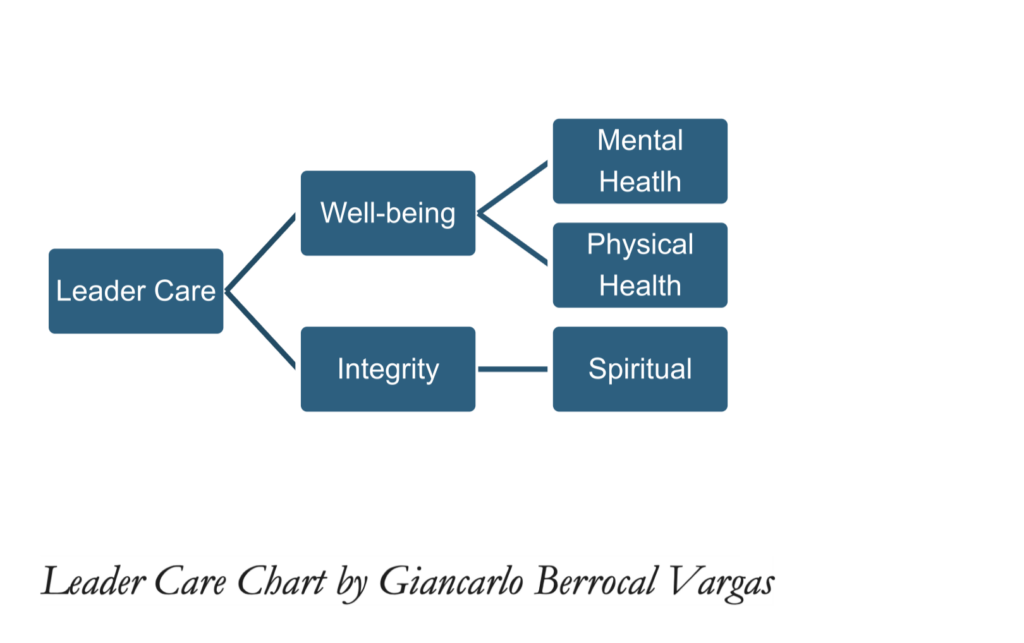
In summary, the implementation of the excellence in leader care standard will lead to a more robust financial accountability and stewardship across ministry and churches. This new standard includes new elements related to mental health, physical health and integrity. This new standard is designed to address the root cause of many financial scandals affecting leaders across ministries and churches.
Giancarlo Berrocal Vargas, CFE, CPA, is a fraud risk professional with more than 15 years of experience in financial services. He has published academic work on nonprofit governance and volunteers to raise awareness of consumer fraud affecting older adults through nonprofit organizations.
TO OUR READERS: The mission of MinistryWatch is to help Christian donors become more faithful stewards of the resources God has entrusted to them. Do you know of a story that will help us fulfill our mission, or do you want to give us feedback about this or any other story? If so, please email us at [email protected].
Access to MinistryWatch content is free. However, we hope you will support our work with your prayers and financial gifts. To make a donation, click here.