
Episcopal Priest Pleads Guilty to Wire Fraud
Rev. Robert Smith allegedly stole from St. Francis Ministries, the adoption and foster care ministry he led.

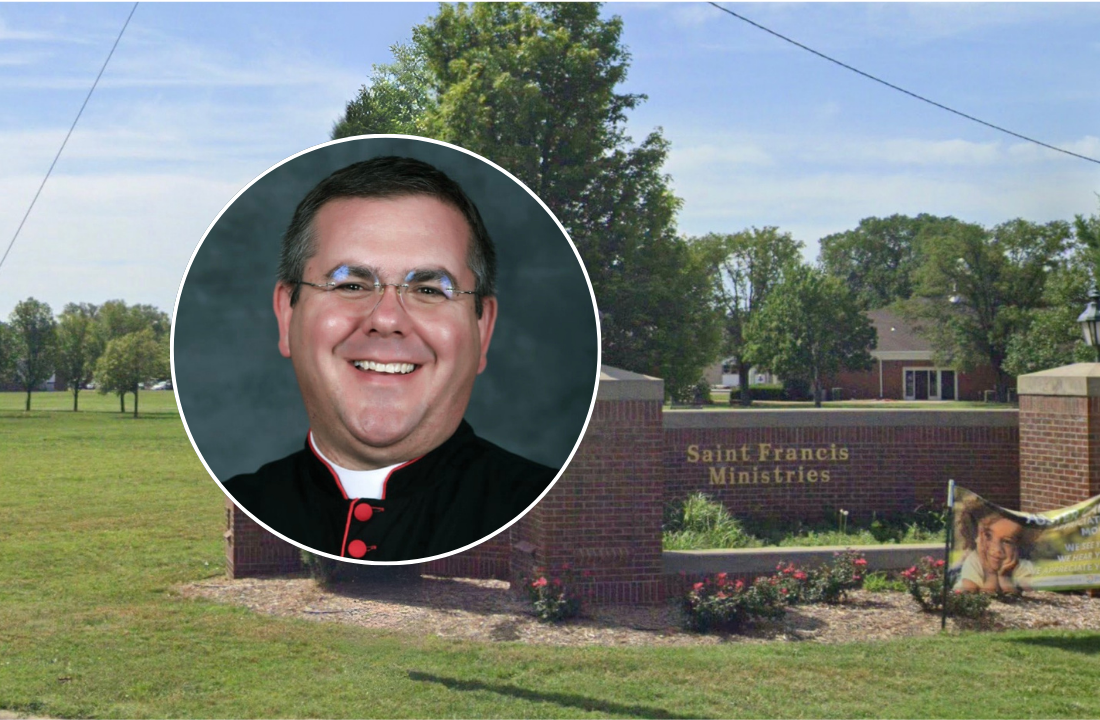
Rev. Robert Smith, an Episcopal priest who led St. Francis Ministries in Salina, Kansas, has pleaded guilty to one count of wire fraud.
Smith was indicted in 2022 for conspiracy to commit wire fraud, 15 counts of wire fraud and one count of money laundering. He pleaded guilty to one charge for using the ministry credit card to charge personal expenses totaling nearly $7,000.
St. Francis Ministries in Salina, Kansas / Insert of Rev. Robert Smith
The maximum penalty for his wire fraud count is 20 years in prison and up to $250,000 in fines. He will be sentenced in July.
Smith led St. Francis Ministries, a foster and adoption ministry, from 2014 to 2020. He was forced to resign when the ministry’s board discovered his mismanagement.
The two-year investigation preceding the indictment found that Smith had approved “materially false invoices” of more than $10 million for technology services provided by William Whymark’s company. Nearly half — $4.7 million — of that allegedly was fraudulent.
In addition to approving the fraudulent invoices from Whymark’s company, Smith is accused of receiving a $50,000 “kickback” from Whymark.
Smith’s financial mismanagement almost pushed St. Francis Ministries into insolvency, according to Episcopal News Service, but it has since recovered—in part thanks to federal COVID-19 Paycheck Protection Program funds.
Smith was suspended from his duties as a priest by Chicago Bishop Paula Clark after the 2022 indictments. After his guilty plea, Clark said the church will undertake its disciplinary process.
Access to MinistryWatch content is free. However, we hope you will support our work with your prayers and financial gifts. To make a donation, click here
“I take very seriously all accusations of clergy misconduct,” Clark said, asking that people pray for Smith, his family, and “and all who are affected by this situation.”
MinistryWatch reached out to St. Francis Ministries for a statement about Smith’s guilty plea and information about procedural changes the ministry has made to prevent future fraud.
In response, Denny Marlin, executive director of communications, said, “For more than 80 years Saint Francis Ministries has provided healing and hope to children and families and that remains our focus. We trust the judicial process and remain committed to serving the children and families who rely on our care.”
Whymark also pleaded guilty in November 2025 to two counts of money laundering. He will be sentenced in April.
St. Francis Ministries has also filed a civil lawsuit in Kansas state court against Smith for conversion — the civil tort name for theft — and breach of fiduciary duty. The case is still pending.
In order to prevent fraud and misappropriation of funds, nonprofits ought to have internal controls in place, according to the National Council of Nonprofits.
The group defines internal controls as “financial management practices that are systematically used to prevent misuse and misappropriation of assets, such as occur through theft or embezzlement.”
It recommends a primer published online by the law firm Venable LLP that details warning signs and recommended preventative measures.
One example of a warning sign related to Smith’s fraud at St. Francis is if “an employee has an unusually close relationship with vendors.” In this case, Whymark and Smith were allegedly friends.
Some examples of internal controls and policies that help prevent fraud include:
- Segregating financial duties so the people paying the bills are not the same ones reconciling the bank account.
- Performing background checks to expose any criminal record.
- Establishing regular external audits and board-level oversight.
- Encouraging whistleblowers to report suspected wrongdoing.
- Acquiring insurance coverage for risks.
The primer also contains advice for investigating suspected fraud or embezzlement.
EDITOR’S NOTE: Why does MinistryWatch report on financial fraud in the church? We report on them because one in three churches will be victimized, according to the Center for the Study of Global Christianity. We also report on them because these crimes have real victims and cost taxpayers and other stakeholders billions of dollars every year. Even small crimes in small churches have huge consequences. We also report on them to remind our readers that they do not have to be victims. There are steps you can take to prevent financial waste, fraud, and abuse in your church or ministry. To find out more, click here.