As Autism Diagnoses Rise, Christian Ministries Adapt
Just 5% of families with autistic children attend church

A recent survey by the Centers for Disease Control and Prevention found that in 2022, autism diagnoses among young children reached the highest rate since the agency began tracking the data in 2000.
Photo via North Way Christian Community Church / Video screenshot
With a prevalence of 1 in 31 children, autism (or at least the diagnosis) is on the rise. Against this backdrop, many Christian leaders are striving to make Sunday morning worship a more welcoming and accommodating experience for neurodivergent members.
For people on the autism spectrum, the sounds, smells, rituals, crowds and social expectations of a church service can be prohibitive. Loud music can trigger sensory sensitivities, meet-and-greets can be anxiety-inducing, and divergences from the expected routine can lead to outbursts.
“In the U.S., only 5% of Christian families who have a child with Autism attend church,” said author and speaker Ron Sandison in a 2024 article for The Art of Autism.
Recently, Sandison made history by becoming the first licensed Assemblies of God minister with an autism diagnosis.
“As a young minister with Autism, my social awkwardness and sensory issues caused me to struggle in conversation with congregants,” Sandison said in the 2024 article. “I had difficulty with eye contact and would often make unfiltered comments that caused people to view me as lacking empathy. … I found some churches socially inhospitable toward Autism and unaccepting of my Autistic quirks.”
Access to MinistryWatch content is free. However, we hope you will support our work with your prayers and financial gifts. To make a donation, click here.
Today, Sandison is among a growing group of advocates raising awareness of steps churches can take to better serve neurodivergent worshipers.
One advocacy group, the Autism Faith Network, advertises its annual Accessible Faith Initiative as an outreach to “equip and empower churches desiring to create an environment that promotes belonging and inclusion.” The group’s Accessible Faith Initiative Toolkit, available as a downloadable PDF, includes recommendations such as noise-canceling headphones, Zoom Bible story times, and respite care events for parents and caregivers.
One accommodation some churches have embraced is the sensory room—a space apart from the sanctuary that allows children and adults with disabilities to participate in services without being overwhelmed. The rooms can include extra insulation, dimmable lights, a microphone volume control dial, and even fidget devices that are used for self-soothing.
Liquid Church, a New Jersey megachurch, offers sensory rooms or “chill spaces” at multiple campuses.
“We have buddies who support [people with special needs], use chill spaces to give them time to reset, and we use sensory toys and adaptive materials,” Pastor Eryn Mera told The Christian Post. “Kids worship in the class with peers, middle schoolers/teens/adults worship with peers in worship or at special events for their age group.”
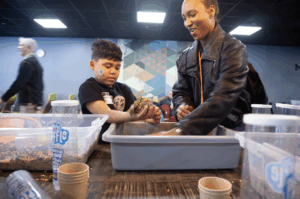
Sensory space for children with special needs / Photo via Liquid Church social media
Churches have also begun organizing ministry groups specifically for those on the spectrum.
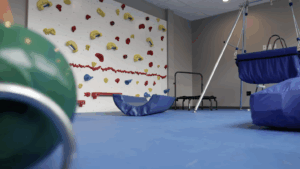
North Way Christian Community Church, a seven-campus megachurch in Pittsburgh, offers an alternative children’s ministry that utilizes multiple autism-friendly spaces. According to the church’s website, these include a quiet/reset room as well as a calming room with dim lights and soothing imagery, a large group room for worshiping together, and a gross motor skills room with a climbing wall, trampoline, yoga balls and other exercise equipment.
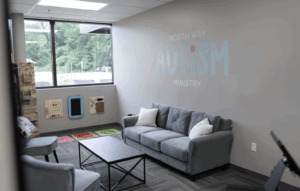
Photo via North Way Christian Community Church / Video screenshot
While not all churches have the capacity to add dedicated rooms, there are plenty of recommendations that don’t require a big budget.
Advocacy group Autism Speaks suggests offering priority seating to help autistic members avoid crowded spaces; posting visuals such as maps or arrows to help navigate the premises; clearly outlining the routines or rituals, including any divergences from the usual schedule, in a printed or digital program; and training staff and church members on interacting with people on the spectrum, such as through Autism Speaks’ Autism Friendly Designation program.
Sandison suggests practical measures such as setting aside a space where autistic children can pace when they struggle to sit still, and implementing a buddy system to help neurodivergent members socialize and participate in activities. He stresses the importance of teaching congregations to understand and tolerate autistic behaviors. Autistic individuals themselves, he suggests, can be invited to share their stories from the pulpit.
“My life is an example,” Sandison wrote in his book “Adulting on the Spectrum,” “that with support, love, and acceptance from family and friends, autism cannot hold us back from reaching our goals in life.”
TO OUR READERS: The mission of MinistryWatch is to help Christian donors become more faithful stewards of the resources God has entrusted to them. Do you know of a story that will help us fulfill our mission, or do you want to give us feedback about this or any other story? If so, please email us at [email protected].